I've run quite a few half marathons by now, some went well, others not so much. Common to all half marathons, however, has been that I've done everything I could to prepare optimally. I've also found a lot of good advice on the internet – and there are really many of them. But common to many of the tips is that they are almost the same. However, I think there are 3 tips that I've never received – but which I find very useful. I don't think you should miss out on them.
1. Follow your own body – not a pacer!
The pacers' task is to maintain a certain pace continuously throughout the race. In this way, you are sure to get a certain finish time as long as you just stay behind the pacer.
However, the impracticality is also that the pacers maintain the same speed throughout the race. It's not necessarily a good thing to run the same speed when the route goes uphill and when the route goes downhill.
Therefore, listen much more to your own body. You may come to a place on the route where it goes slightly downhill, here you can advantageously press a little more on the accelerator. Conversely, there will certainly be some climbs along the way, here it may be more appropriate to ease a little on the gas pedal and safely get over this climb.
In this way, you economize more with your energy so you can make the decisive final sprint at the end.

2. Smile
Okay, this is going to sound funky, but a study from Ulster University suggests that smiling has an effect on how we run. The researchers behind the study had 24 runners run a series of six-minute intervals while either smiling, frowning, or trying to relax their bodies. The result indicated that the runners used less oxygen and experienced the run as less hard when they smiled compared to when they frowned (Brick et al., 2018).
It's worth mentioning that the effect was greatest at high intensity and that it wasn't equally clear in all participants - but the results point towards a smile actually making a difference.
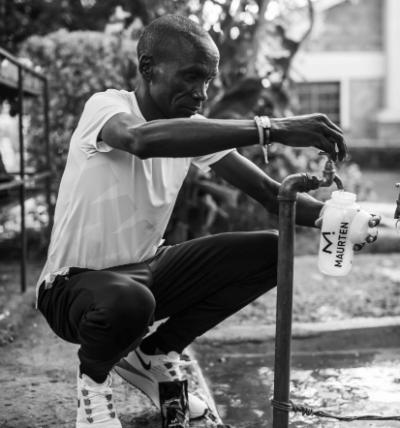
When the world's best marathon runner, Eliud Kipchoge, ran a marathon in Vienna in 1 hour 59 minutes and 40 seconds (!!), he was seen smiling several times along the way. Maybe it wasn't just to give people a good experience - it may also have helped his running economy.
So smile at your surroundings. Use the energy from the audience. It's a party to run a half marathon. Take advantage of it.
3. It's okay to be hard
A rule of thumb is that it shouldn't be too hard the first 10 kilometers. You should preferably feel a surplus the first 10 km. It's also cooler to have a little to shoot with at the end, so save your energy. Run after a so-called 'negative split', where you run the first half of the race a little slower than you run the last half.
That said, a half marathon can be hard. And it's about accepting that it's hard. Remember to tell yourself when it gets hard that this is exactly what you've trained for. You've prepared your body for this performance. You can definitely handle it. Welcome the pain, and then ask it to sit in the back of the bus. It's your race. You are in control.
And with these three tips, I hope you have the world's best run! You are awesome. You've now trained for a longer period and it's now time to reap the rewards.
Good run!
Even more half marathon?
Are you planning your next half marathon, the next step is typically a structured training program. See our
, where you can follow a week-by-week plan up to race day.
At the same time, if you need to get your gear in order, shoes are often the first place to start. Check out our guide to , or find your next pair in our .
Source:
Brick, N.E., McElhinney, M.J. & Metcalfe, R.S. (2018). The effects of facial expression and relaxation cues on movement economy, physiological, and perceptual responses during running. Psychology of Sport and Exercise.