Avoid "Runner´s stomach" in your daily workouts
For your daily workouts its all about finding a solution which works on an everyday basis. Its also worth mentioning that if you don´t experience any problems in your current routine, then there is probably no reason to make any big changes.
Intensity in workouts
If you are going jogging, you can probably manage a lot. When you go running the body adjusts the blood supply so the muscles you use for running get more blood. This is done by constricting blood vessels to other areas to reduce the blood supply.
If you run with very high intensity, the muscles demand as much blood as possible as its the blood which delivers oxygen for the muscles among other things. In other words, this means that the blood supply to your digestion is reduced. The result is a slower digestion, and therefore it can be difficult to absorb certain foods which require the digestive system to be fully operational.
So, our advice is that you are a little extra careful with what you eat if you´re going out for a high-intensity workout.
Time-delayed response
When you eat, it takes times time before the food is properly digested. Depending on what you eat there is also a difference; a piece of white toast is digested much faster than a slice of rye bread.
If you want to know how quickly certain types of food are digested, you can check out where the particular type of food is placed within the "glycemic index". The glycemic index is a scale from 0-100, where 100 is the fastest absorbable type of food.
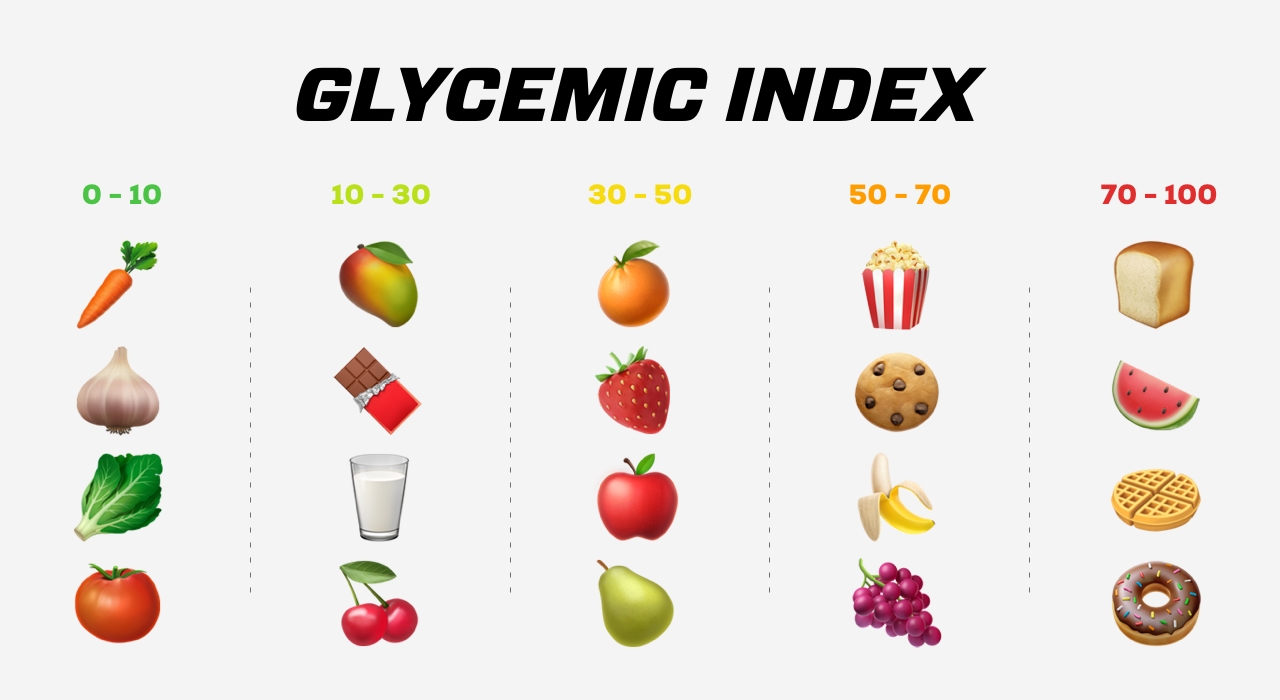
At the top of the scale you´ll find white rice, white bread and watermelon. In the middle you´ll find milk, yoghurt, beans and apples, and at the bottom brown rice, onions, broccoli and tomatoes. In addition foods containing lots of fat and protein are also slowly absorbed - i.e. fish and eggs.
With all of the above in midn its a good idea to eat in a way, so your digestive system isn´t too busy when you are heading out for a high-intensity workout. In pratice this means that it can work to your advantage if you stick with types of food with a higher position on the GI-scale before high-intensity workouts.
Avoid "Runner´s stomach" for racing
Basically the same applies to racing as to high-intensity workouts. However, there is a difference that during training you have the time to figure out what works best for you. Of course we don´t recommend that you experiment during a race - in this case you need to choose what works best for you.
Leading up the race
Besides the fact that you may have individual preferences which you should rehearse in advance and consider for the race day, literature has the following recommendations in relation to your last meal before the race (around three hours before the race) – The recommendation must be seen in relation to your normal diet:
- Less coffee
- Less fat
- Less protein
- Less carbohydrates
- Less fibres
- More water (but not too much)
If you get problems with your stomach leading up to the race even though your least meal seems to be optimal, then you should think about your dinner the day before. If you enjoy a very "heavy" meal the night before the race you can risk having some challenges. In total it can work to your advantage if you a couple of days before the race eat less fibres and especially on the day of the race eat more light food.
Of course you shouldn´t starve yourself in the days leading up to the race as you risk not having enough energy when you start. Try to experiement how you should eat in order for you to feel most ready, light and fit on the day of the race.
During the race
During the race you should stick to simple food and water (if you need it). The most simple thing is to stick to products which are made for the purpose. This improves your chances that your stomach will accept it appropriately - But still remember to test it during your workouts.
If you want to read more about the use of energy products during training, I have written a whole article about it, which you can find here: ”Guide: How to use energy before, during and after running"
References
- Parnell JA, Wagner-Jones K, Madden RF, Erdman KA., Dietary restrictions in endurance runners to mitigate exercise-induced gastrointestinal symptoms (2020)
- Scrivin R, Costa RJS, Pelly F, Lis D, Slater G., An exploratory study of the management strategies reported by endurance athletes with exercise-associated gastrointestinal symptoms (2022)