
Overview:
Easy Run
The easy run is where you prepare your body for the next session. You should finish thinking, “I could easily have kept running.” If that’s not the case, you may have gone too fast.
The feeling throughout the run should be one of ease, and it’s absolutely fine to take breaks. This type of training won’t make you faster – but it’s essential for your development as a runner.

Try to find a running partner at the same level – or even better, someone who runs a little slower and can help you keep the pace down.
If you’re running with someone else who’s also doing an easy run, you should both be able to carry on a full conversation throughout.
The easy run is also your warm-up on days when you have strides, hill sprints, or interval sessions.
Intervals
On days with intervals, it’s important to start with at least 2 km of warm-up at the same effort as an easy run. This gets your body ready and helps reduce the risk of injury.
After your warm-up, take up to ten minutes’ break to change shoes if needed and do a few warm-up drills.
For example, dynamic leg swings and a few strides.
Then you begin your first interval. This could be done on a track or a loop where you know the distance.
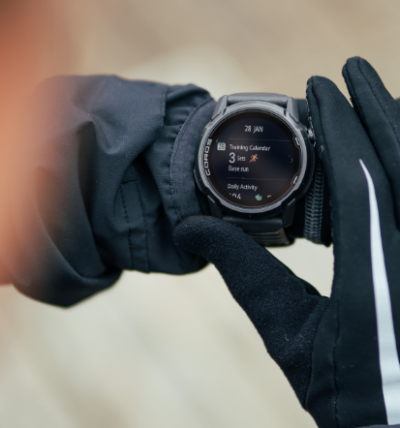
Alternatively, track your distance using your watch and use the “lap” button to mark each rep, rest, and total distance. The button is on the bottom right on both and .
When you press the button, a new lap starts, with time and distance counting up from zero. When you’ve run 1000 meters, press the button again to start your rest period.
Time your rest to be 90 seconds. This way, you can keep your watch running and still monitor your heart rate during the rest.
Repeat until you’ve completed the workout.
You should be out of breath and unable to carry on a full conversation.
Start the first interval calmly, so you can run faster at the end. Ideally, your first interval is the slowest and the last one is the fastest.
When you’re done, do a cooldown jog – run any remaining kilometers needed to meet your day’s total, at easy run intensity.
Strides
A stride is a short interval that you track like a normal interval.
However, distance and time are less important here. Instead, focus on running at a fairly high speed for 15–20 seconds.
Over those 15–20 seconds, gradually increase your speed so that you feel like you're sprinting in the final seconds.
You should be out of breath afterward and rest for at least 45 seconds. Track it just like you would in an interval workout.

When you’re done, jog the remaining kilometers at an easy pace to meet your daily distance.
Hill Repeats
Hill repeats are intervals done uphill. Find a hill – the steeper, the better – and choose a fixed starting point (like a lamp post or a recognizable tree).
Run hard uphill for about 20 seconds. Mark the lap using your watch, as you would in an interval session. Your rest is the walk or jog back down.
You should be very out of breath after each interval, and the jog back can be long.
When finished, jog the remaining kilometers at easy run intensity to meet your daily target.
Injuries
If you experience pain during the challenge, we recommend taking at least a week off from running.
Gently massage the sore area with a foam roller or similar. Consider seeing a physiotherapist.
Need more inspiration?
Find more articles in our inspiration universe here:
Inspiration and articles – click here