

It hurts along the inside of the shin for the first few kilometers. Then it eases as you run. The next day it's back, a bit earlier than last time.
Shin splints are among the most common running injuries, and they tend to linger. Many take a break, stretch, and start cautiously again. Then it's back after a few weeks. Here you get an overview of what's happening in the shin, why the pattern repeats, and how to rebuild the leg.
Shin Splints - Do I Have Inflammation in My Leg?
Shin splints are known in research as medial tibial stress syndrome (MTSS), defined as load-induced pain along the lower, rear inner edge of the shin, where pain can be reproduced by pressure over a stretch of at least five centimeters. The broad, diffuse tenderness is the hallmark.
It's not a classic inflammation. For a long time, the condition was explained as irritation of the periosteum, caused by pulling from the calf muscles. That picture doesn't quite hold. Recent reviews point towards an overload of the bone itself, where bone tissue breakdown temporarily outpaces rebuilding, combined with pulling from surrounding connective tissue (Saad et al. 2025). The precise tissue source is still debated, but there's broad agreement on the mechanism: the leg has received more load than it could handle. Bone is living tissue in constant remodeling. If you load it appropriately and give it time, it becomes stronger. If you load it faster than it can keep up, micro-damage accumulates, which doesn't get repaired in time.
This has two consequences worth noting. First, it doesn't make sense to chase inflammation with ice and anti-inflammatory medication. Second, shin splints and tibial stress fractures are related load conditions. One doesn't automatically develop into the other, but they resemble each other enough that you should react if the pain changes from diffuse to sharp and localized. And it pays to act while the pain is still diffuse.
Why Do You Get Shin Splints?
The core issue is a mismatch between load and capacity, and often it's the load that has increased too quickly. A new running routine, a sudden increase in weekly kilometers, more speed, or more hills in a short time. The shin is particularly vulnerable in the first months of a running program, where the bone hasn't yet adapted.
Meta-analyses of risk factors consistently point to a few factors: female gender, previous episode with shin splints, higher BMI, greater navicular drop (i.e., a foot arch that sinks significantly under load), and few years of running experience (Hamstra-Wright et al. 2015; Reinking et al. 2017). A newer meta-analysis adds foot position and how much the foot arch changes during walking as independent factors (Lee et al. 2025).
Note what's not on the list: running style, surface, and shoe type are not well-documented causes. And several of the documented factors can't be changed. What you can change is the load and capacity.
On the capacity side, there's something concrete to work with. Runners with shin splints have measured lower strength in the soleus, tibialis anterior, big toe flexor, and lateral ankle muscles, as well as significantly lower endurance in the calf muscles compared to matched runners without symptoms (Mattock et al. 2021). The study can't determine whether the weakness came before or after the injury, but the calf muscles are what dampen the force through the shin with each step. If they can't absorb it, it goes to the bone.
Is It Shin Splints or a Stress Fracture?
This is the first thing you need to clarify, as the two conditions are handled differently. The typical picture with shin splints is broad, diffuse tenderness along the inner edge, which eases when you're warmed up. A stress fracture more often causes sharp pain at one specific spot, which worsens the longer you run.
| Signs and What They Indicate | |
|---|---|
| Shin Splints | • Diffuse tenderness over 5 cm or more • Eases after warming up • Worst first steps in the morning |
| Stress Fracture | • Sharp pain at one small point • Worsens during the run • Can hurt during normal walking |
If in doubt, get it assessed. A final diagnosis should be made by a medical professional.
There's also a third condition that can be mistaken for shin splints. In chronic compartment syndrome, the pressure in one of the lower leg's muscle compartments increases while you run, because the muscle swells more during activity than the surrounding fascia can accommodate. This causes a pressing or burning sensation, often with tingling or weakness in the foot, and the hallmark is that symptoms appear after a certain number of minutes of running and disappear relatively quickly when you stop. It doesn't respond to load management in the same way as shin splints, so if you recognize the pattern, you should have it assessed rather than trying to manage it yourself.
Rest Is Not a Treatment in Itself
The advice to take a break until the pain is completely gone fails for the same reason as with other overload injuries. Tissue doesn't get stronger by being spared. It gets stronger by being loaded in a dosage it can handle.
This doesn't mean rest never has a place. If it hurts just to walk, many find it beneficial to wait with running until they can walk pain-free for a few days. This was also the starting point in studies that tested graduated running programs. But see it as a short runway, not the treatment itself. The problem arises when the break turns into weeks without a plan for how to build up the load again.
If you stop running for a long time, the pain disappears because the load is gone. Capacity falls at the same time. When you start again, you face the same amount of running with a shin that now tolerates less than before. That's why many experience shin splints as a recurring issue.
Where the limit lies for you, no article can determine in advance. Use the pain traffic light below, experiment in small steps, and let the reaction the next day be the judge.
Alternative training like cycling and swimming has its place if you need to maintain fitness. But it doesn't build the specific bone capacity you lack. Only loading through the leg does that.
How to Keep Running with Shin Splints
Most with shin splints can continue running in a modified form. The best-documented approach is a graduated running program: you find the level you can tolerate and build up from there in small steps. In a randomized study with athletes, neither the addition of calf stretches and strength exercises nor compression socks provided any extra effect on top of the graduated running program itself (Moen et al. 2012). It's the dosage itself that carries the result.
Management is done via a simple pain scale from 0 to 10.
| Pain Traffic Light | |
|---|---|
| ●Green 0–2 | Mild discomfort, gone the next day. Continue and increase as planned. |
| ●Yellow 3–5 | Increased tenderness, but back to baseline the next morning. Maintain amount, don't increase. |
| ●Red 5+ | Clear pain, limping or worse the next day. Reduce. |
Pain scale from 0 to 10, where 0 is no pain.
The key is the reaction the next day. The shin may make itself known during the run, as long as it's back to baseline the next morning. If it's worse, the load was too much.
In practice, the early phase means short, frequent runs at a slow pace, flat terrain, and no speed. Walk-run intervals are a strong tool because they keep the total load down and make it possible to be active more often. Gradually extend when the rhythm is stable without reaction, and only add speed and hills at the end. The sequence is frequency, then amount, then intensity.
Strength Training Builds Capacity
While modified running keeps the shin active, it's strength training that raises the ceiling for how much the leg can handle. The goal is the strength and endurance of the calf muscles, the foot and ankle muscles, and the hip, which determines how the load is distributed downthrough the leg.
Heel raise with straight knee
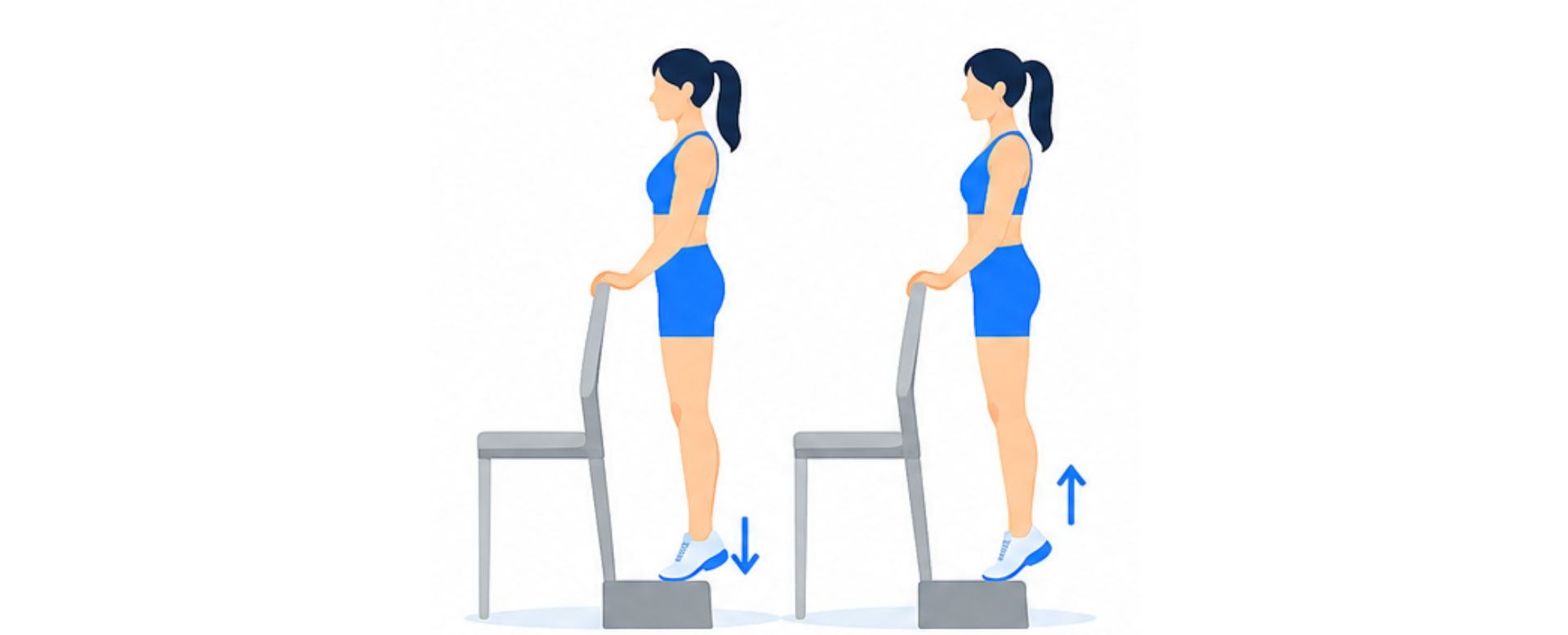
Stand on the edge of a step on one leg. Slowly lift the heel over 3 seconds, hold briefly at the top, and lower in a controlled manner over 3 seconds below step level. Add weight in a backpack when it becomes too easy.
Heel raise with bent knee
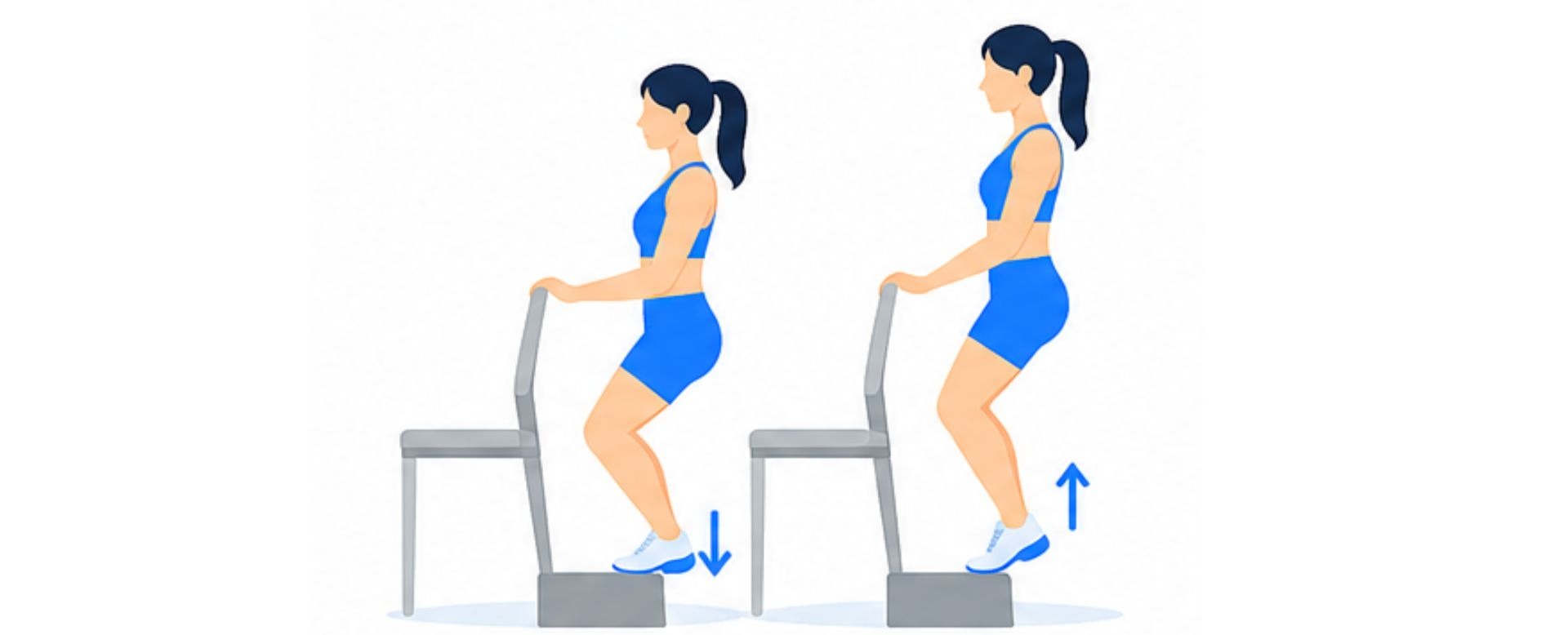
Same movement, but with the knee bent about 30 degrees. This shifts the work to the soleus (the deep calf muscle), which bears most of the force through the shin during running.
Toe raise against resistance
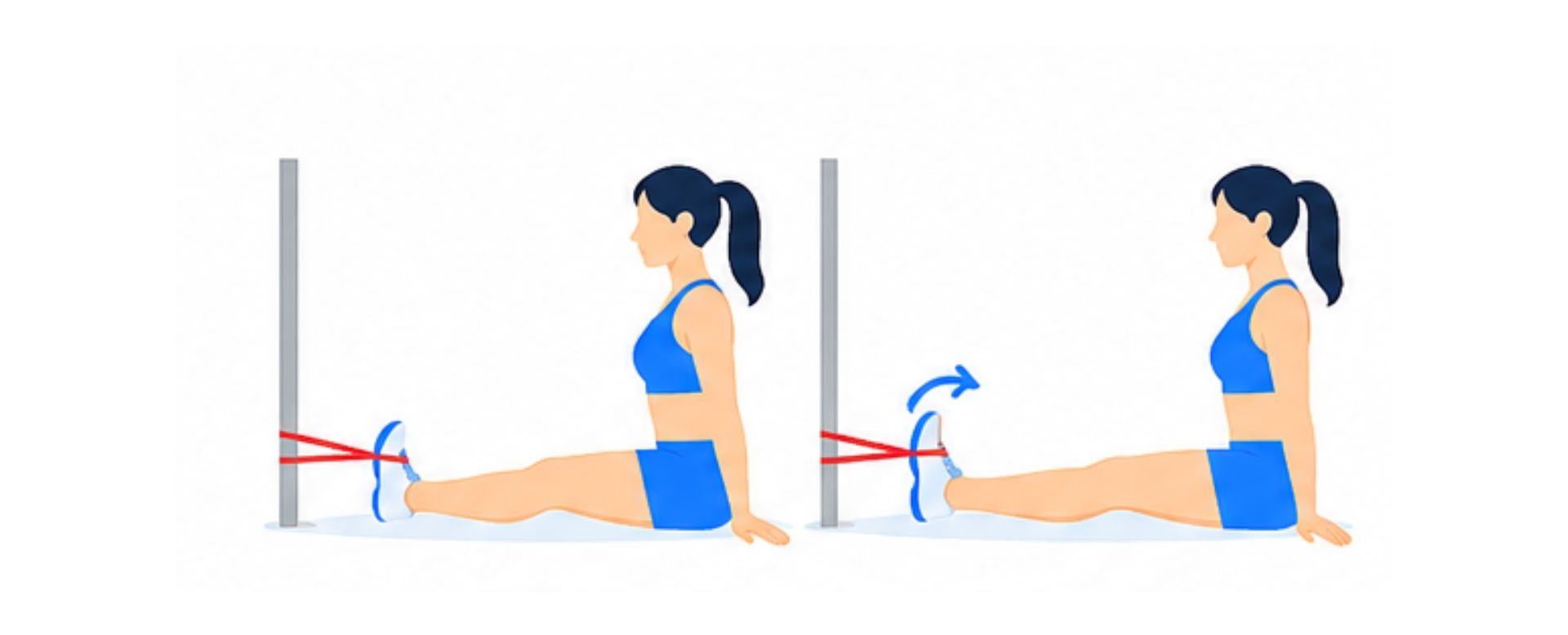
Place a resistance band around the forefoot and pull the foot up towards the shin against the resistance. Slowly lower back. The exercise trains the tibialis anterior on the front of the shin.
Short foot and big toe press
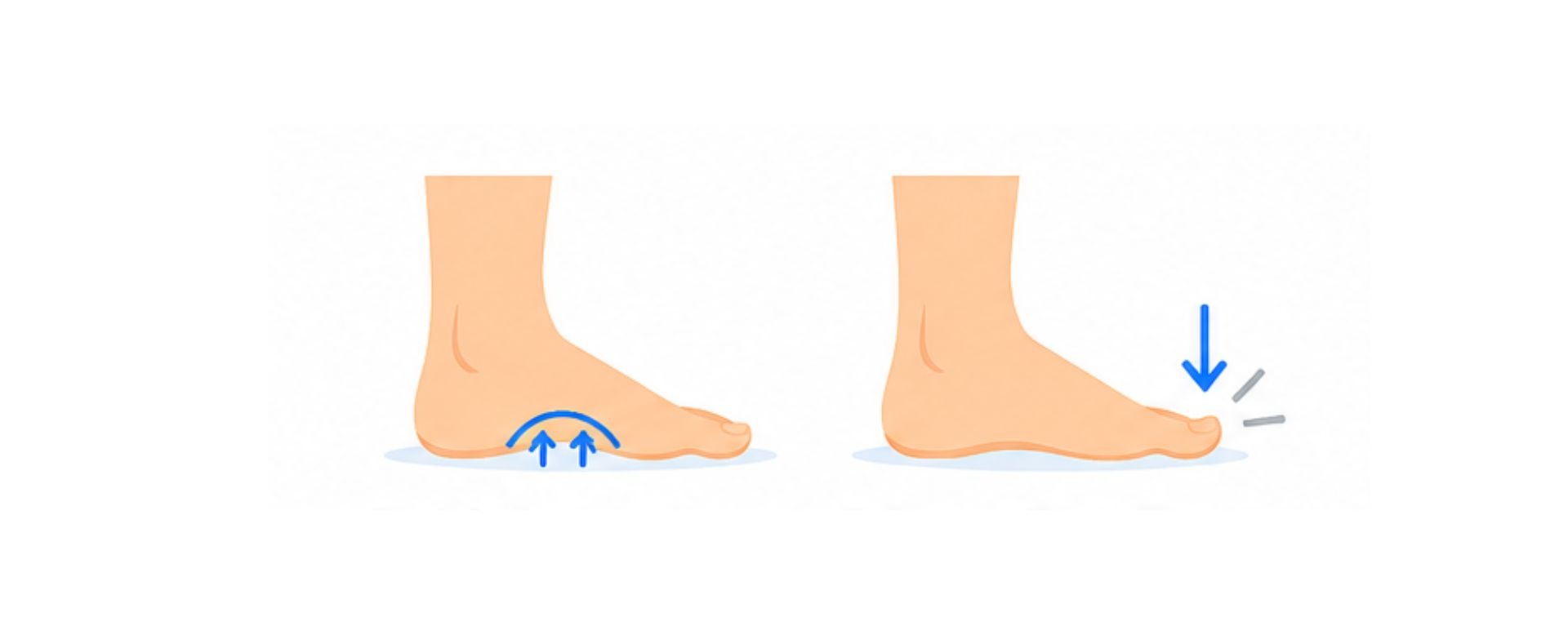
Sit with the foot flat on the floor. Contract the arch without curling the toes, and hold the tension for 5 seconds. Then press the big toe into the floor without lifting the other toes. This activates the small muscles that control the arch under load.
Single-leg hip thrust
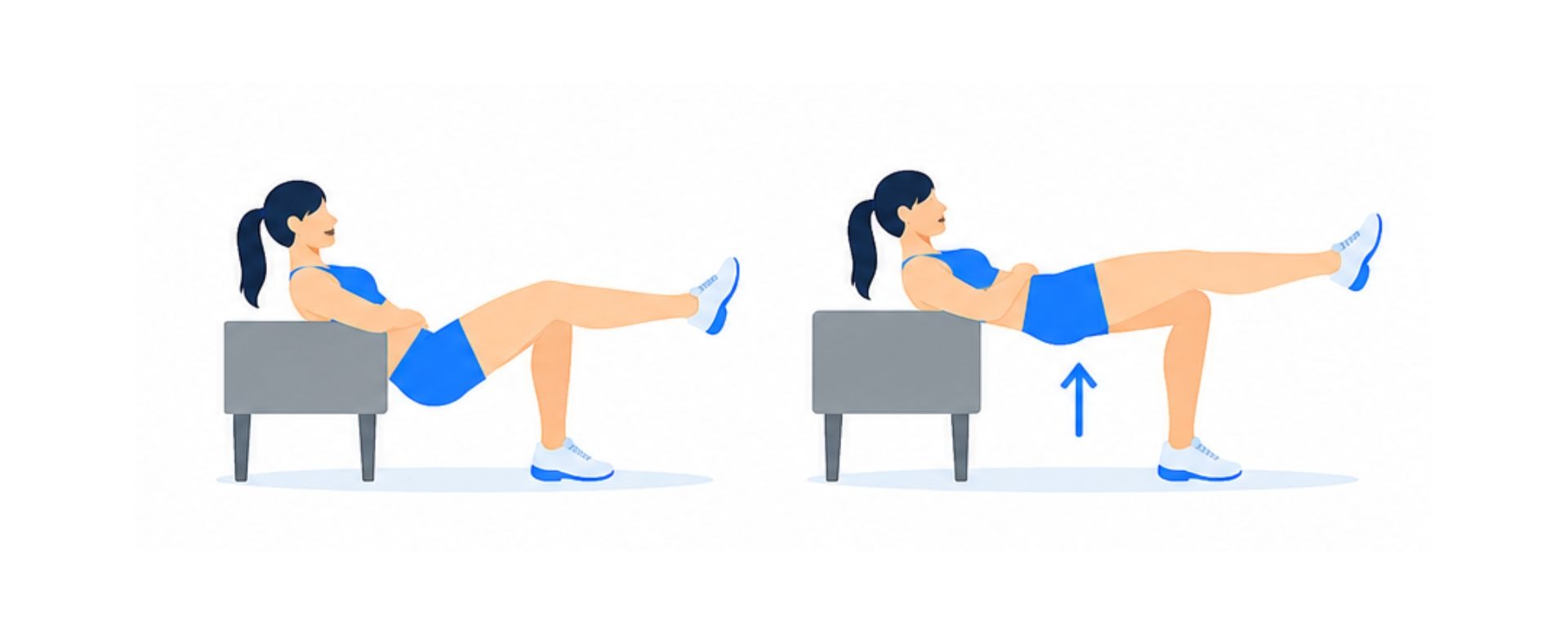
Place upper back against a sofa or bench with one foot on the floor and the other leg extended. Push the hip up until the body forms a straight line from knee to shoulder, and squeeze the glute at the top. The hip helps determine how the load is distributed down through the leg.
| Exercise | Dosage |
|---|---|
| Heel raise, straight knee | 3 × 8–12 per leg |
| Heel raise, bent knee | 3 × 10–15 per leg |
| Toe raise against resistance | 3 × 15 per leg |
| Short foot and big toe press | 3 × 10 hold per foot |
| Single-leg hip thrust | 3 × 10–12 per leg |
Load beats repetitions
The most common mistake is quick heel raises without weight. Bone and tendon adapt to mechanical load under controlled tempo, not the total number of repetitions. Choose a weight or variant where the last two to three reps are hard but still have correct technique.
Two sessions a week is the minimum, three is optimal. Consistency over time matters more than intensity in a single session. Ideally, do strength training on the same day as your hardest run to consolidate load and free up days for recovery. Maintain with one session a week when pain-free. Maintenance can help prevent relapse.
If you want the full program for lower leg, hip, and core, we've compiled it in our .
What about insoles, compression socks, and massage?
The tools have a place in the process when you know what to expect from them. They relieve and support while the active part does the work.
Insoles and shoes +
- No clear documented effect
- Can change load along the way
- Part of treatment, not the solution alone
- Change shoes gradually, never overnight
Compression socks +
- No documented effect on recovery time
- Many experience support and less tired legs
- Use them as part of the solution for comfort
Massage gun and foam roller +
- Can reduce soreness and stiffness in the calf
- Makes it easier to complete running and strength
- Massage the calf, not the bone edge
Stretching +
- No documented preventive effect
- Can relieve morning stiffness
- Prioritize strength over stretch
How long does it take to get rid of shin splints?
Tissue takes time, and it cannot be rushed. In studies where athletes follow a graduated running program until they can run 18 minutes at high speed without pain, the average time is about three months. If caught early, while pain only occurs under high load, it often goes faster. If it has persisted for months, it takes longer.
It's the wrong timeline to measure daily. Instead, measure if you can run longer before pain occurs, if morning soreness decreases week by week, and if you lift more in heel raises than when you started. These are the three things that tell if you're on the right track.
When should I seek help?
You can get far on your own with patient load management and strength training. Have it assessed by a running-specialized physiotherapist or doctor if:
- Pain can be localized to one small point, or a single hop provokes sharp pain.
- You have pain at night or at rest, or the area swells.
- There is no progress after six to eight weeks of targeted work.
- You experience cramping, burning sensation, or tingling in the foot during running.
- The same problem has recurred several times.
- You train a lot and eat little. Low energy availability is an independent risk factor for all bone stress injuries and should always be assessed in repeated cases.
Summary: the five key points
- It's not a classic inflammation. It's an overloaded lower leg where the load has exceeded capacity. If pain changes from diffuse to sharp and localized, a stress fracture should be ruled out.
- Prolonged rest won't solve it alone. Short rest may be necessary if even walking hurts, but it's adjusted load that makes tissue stronger.
- Graduated running is the best-documented approach. Control is based on the reaction the day after, not the pain during the run.
- Heavy, slow strength training of calf, foot, and hip builds the capacity that prevents relapse.
- Insoles, compression, and massage can relieve and support along the way. Use them as a supplement to the active part
Want to read more?
If it's about how to build load without ending up here again, start with . If other areas are troubling, we also have guides to , and .
Need new ? Change gradually and give the leg a few weeks to adjust. A makes it easier to monitor cadence and weekly volume, so you can see if you're increasing too quickly. And if you need something to make the start more comfortable, find compression socks, resistance bands, and foam rollers under .
Sources
- Hamstra-Wright, K. L., et al. (2015). Risk factors for medial tibial stress syndrome in physically active individuals. British Journal of Sports Medicine.
- Lee, I., et al. (2025). HowMedial tibial stress syndrome is influenced by alignment, motion range, strength, and gait biomechanics. Journal of Sport Rehabilitation.
- Mattock, J., et al. (2021). Lower leg muscle structure and function change in long-distance runners with medial tibial stress syndrome. Journal of Foot and Ankle Research.
- Moen, M. H., et al. (2012). Treating medial tibial stress syndrome in athletes. Sports Medicine, Arthroscopy, Rehabilitation, Therapy & Technology.
- Reinking, M. F., et al. (2017). Medial tibial stress syndrome in active people. Sports Health.
- Saad, M. A., et al. (2025). Medial tibial stress syndrome: Epidemiology, biomechanics, and risk factors. Cureus.