
Most believe that running makes you a better runner. That's only half the story. The run itself actually breaks down the body. It's in the hours and days after that the body rebuilds itself, and if you've hit the right load, it rebuilds a bit stronger than before.
This principle is called supercompensation, and it's the foundation of all modern training theory. Understanding it also makes it easier to see why recovery isn't the same as being lazy, and why both too much and too little training can hold you back.
What is supercompensation?
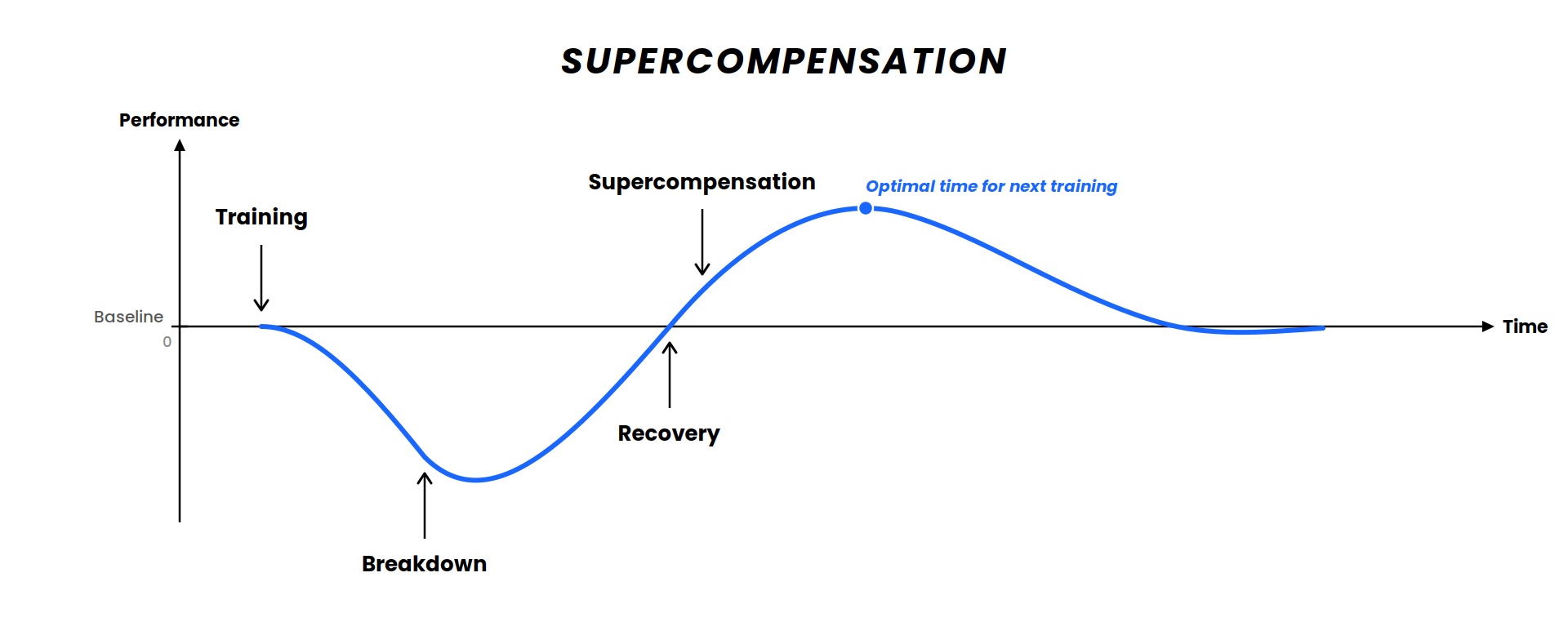
Supercompensation is the body's response to stress. The theory is a cornerstone of all modern training theory, and the principle underlies almost all structured training regardless of sport and level. The principle is simple. When the body is exposed to a load it's not used to, three things happen in sequence.
- First, fitness drops slightly. You're tired after the run, muscles are broken down, energy stores are depleted. It's not a problem. It's intentional.
- Then the body recovers. It repairs what's broken down, refills energy stores, and adapts.
- Finally, and this is crucial, the body doesn't just return to baseline. It builds a notch higher
That's supercompensation. The body prepares for the next time you run.
Three Scenarios: When Should You Run Again?
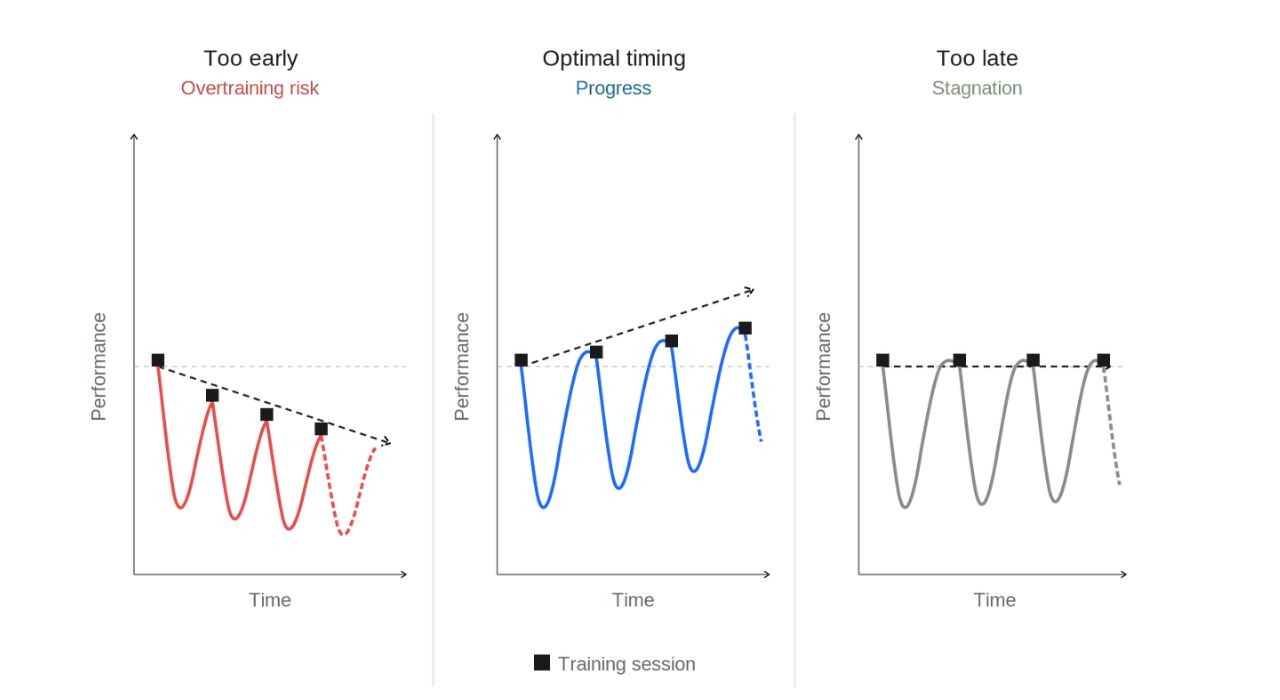
The smart thing about supercompensation is not just understanding the curve. It's understanding what happens if you get it wrong. If you train too early, before the body has had time to recover, you start a new breakdown phase before the previous one is complete. Over time, fatigue accumulates faster than progress. This is where overtraining can occur.
If you train at the right time, at the peak of supercompensation, you start the next run from a slightly higher level than last time. Repeated over months, this is exactly how progress is made. If you wait too long, the body returns to baseline. The supercompensation window closes, and you don't start from a higher level, but from the same.
In practice, this means consistency beats intensity. It's more important to go regularly than to have perfect training sessions with too much time in between.
Recovery Time and Structural Adaptation Are Not the Same
When you run, two different things happen in the body, each with different time horizons.
Recovery time is how long it takes the body to recover from a single training session. To repair micro-damage, refill energy stores, and be ready for the next load. It's measured in hours and days.
Structural adaptation is the slow remodeling of the tissue itself. The muscle gets bigger, the bone denser, the tendon stronger. It's measured in weeks, months, and for tendons even longer. It requires repeated stimuli over time, not a single session. As a rule of thumb, when the load exceeds what the tissue can handle, you get an injury. Your fitness and muscles may be ready for more, but if the tendon hasn't kept up, it's the tendon that gives out first.
| Recovery Time vs. Structural Adaptation | ||
|---|---|---|
| Tissue | Recovery Time (after one session) | Structural Adaptation (repeated stimuli) |
| Conditioning (heart and lungs) | 12 - 48 hours: depending on intensity and duration | Weeks to months |
| Muscles | 24 - 72 hours: depending on intensity and duration | Weeks to months |
| Tendons | Collagen synthesis peaks at 24 hours, elevated for 72+ hours | Months to years |
| Bones | Not measurable after a single session | Months |
The practical problem is that your conditioning improves much faster than your tendons do. You can quickly feel that you can run longer and faster, but that doesn't mean your tendons are ready for it. Increasing the load based on your conditioning rather than your body's overall state can lead to injuries.
Not All Training Requires the Same Recovery
The harder the training, the longer supercompensation takes. This means different types of runs require different planning.
| Training Type and Recovery Time | ||
|---|---|---|
| Training Type | Example | Recovery Time |
| Easy Run | 30 min at conversation pace | 12 to 24 hours |
| Interval Training | 5 × 1000 m at 10 km pace, 2 min rest | About 48 hours |
| All Out Session | 3 × 1000 m as fast as you can, 10 min rest | Up to 5 days |
An easy run serves both as conditioning and active recovery. You can run it often. An interval session significantly improves your fitness level, but the body needs time to catch up. An all-out session should be used sparingly and not stacked.
What does this mean in practice? That your training week can benefit from mixing intensities. A hard interval session on Tuesday, an easy run on Thursday, and a long run at an easy pace on the weekend is a classic and well-tested pattern because it respects supercompensation times.
This is What Stagnation Looks Like and This is What Progress Looks Like
If you run roughly the same every week, at the same pace and over the same distances, you've likely stopped developing. If your week looks like this:
- Tuesday: 5 km at an easy pace
- Thursday: 5 km at an easy pace
- Saturday: 5 km at an easy pace
...then it's a classic sign of stagnation. It feels like consistency, and it is. But the body has long since adapted to the load and is no longer challenged enough to supercompensate to a higher level. You're training to maintain, not to develop.
Progress doesn't necessarily require more time, but a different effort. Imagine the same week, just with variation:
- Monday: rest
- Tuesday: intervals
- Wednesday: rest or 30 min very easy run as active recovery
- Thursday: 5 km at moderate pace
- Friday: rest
- Saturday: long run 7 to 8 km at easy pace
- Sunday: rest
Same number of training days, same time commitment roughly, but now with variation inintensity and gradual progression. It's enough to keep the supercompensation curve upward. It doesn't need to be more complicated than that. An interval run, a moderate run, a long run, and at least 48 hours between the hardest sessions.
Want to read more about recovery? Read our
, where we delve into sleep, nutrition, active recovery, and how to plan breaks in your week.
You can't control everything - and that's okay
Supercompensation is a principle, not a formula. Bodies are different. Age, sleep, stress, nutrition, and genetics all affect how quickly you recover and adapt. This means two runners can follow the same plan and develop differently. Use the principle as a guide and listen to your body. If you feel constantly tired, have persistent pain, or your form stagnates despite training, it's a sign that the balance between load and recovery isn't right.

Want to become an even better runner?
Now you know how the body adapts to training. The next natural step is to ensure you have the right gear to train in and strengthen your body in the right ways. If you haven't already sorted your , it's a good place to start. The right shoe makes a real difference for your running experience. The same goes for , suited to pace and weather.
Want to take your running to the next level, we also recommend reading our article on . Strong muscles and tendons are one of the most effective ways to support the structural adaptation we've discussed in this article.