
When today's training is done, and you press “Save” on your , you're presented with lots of data. Data that can sometimes be tricky to understand. Among other things, you'll see the “Training Effect” showing the relationship between “Aerobic” and “Anaerobic” – terms runners often come across when reading about training. But what do these terms actually mean?
With and without oxygen
If you search for “aerobic” on Wikipedia, you'll read that the word comes from Greek “aer,” meaning air, and “bios,” meaning life. It's about biological processes that only occur when oxygen is present. Add “an” in front, and it means processes that can occur without oxygen.
Aerobic = Biological processes that require oxygen.
Anaerobic = Biological processes that can occur without oxygen.
And what does this mean for you?
Simply put, when you run at low intensity (slowly), your body mainly gets energy from AEROBIC processes – and when intensity is high (you run very fast), energy mainly comes from ANAEROBIC processes.
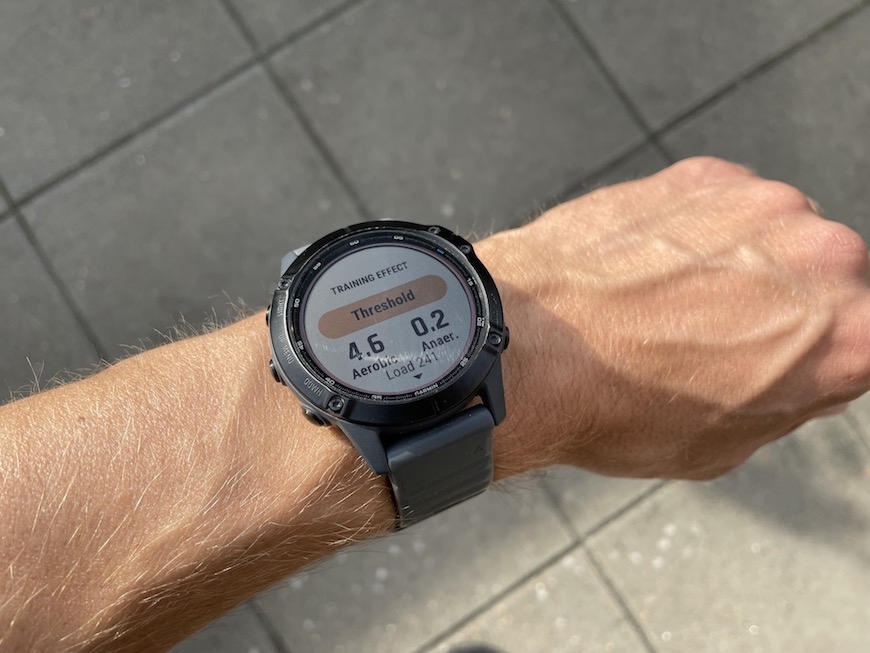
So what Garmin tries to convey with this division into Aerobic and Anaerobic is where your body got its energy from, and thus what benefit or training effect you got from today's run.
This will be explained further in the following sections.
The body's energy
To run, you need energy. The muscles that swing your leg forward, absorb the impact at landing, push the body forward when you accelerate, and stabilize the torso throughout the movement all require energy. In the body, this energy exists as a molecule named ATP (aka. adenosine triphosphate).
Since ATP is the body's fuel, it would be smart to store a lot of it in the body. However, ATP is a very heavy molecule. In fact, it's so heavy that an average adult lying in bed all day would need to store 65 kg of it just to survive. A 10 km run would quickly require up to 36 kg of ATP. A bit impractical to carry around while running.
The body's solution is to constantly generate new ATP. It does this from stored carbohydrates and fats, and this is where the terms ‘aerobic’ and ‘anaerobic’ come into play again. While fat-based energy production can only occur when there's plenty of oxygen, carbohydrate-based energy production can occur both with and without oxygen.
A question of intensity
To know which energy system is most active, you need to look at the intensity of the activity.
One of the key differences between the aerobic and anaerobic energy systems is the speed at which energy can be produced. The anaerobic system delivers energy much faster and will thus supply a larger portion of the energy when the intensity is higher.
If you sprint 100 meters at full speed, almost all the energy will come from the anaerobic processes, while the aerobic processes handle nearly all the work when you jog a short recovery run or run long runs.
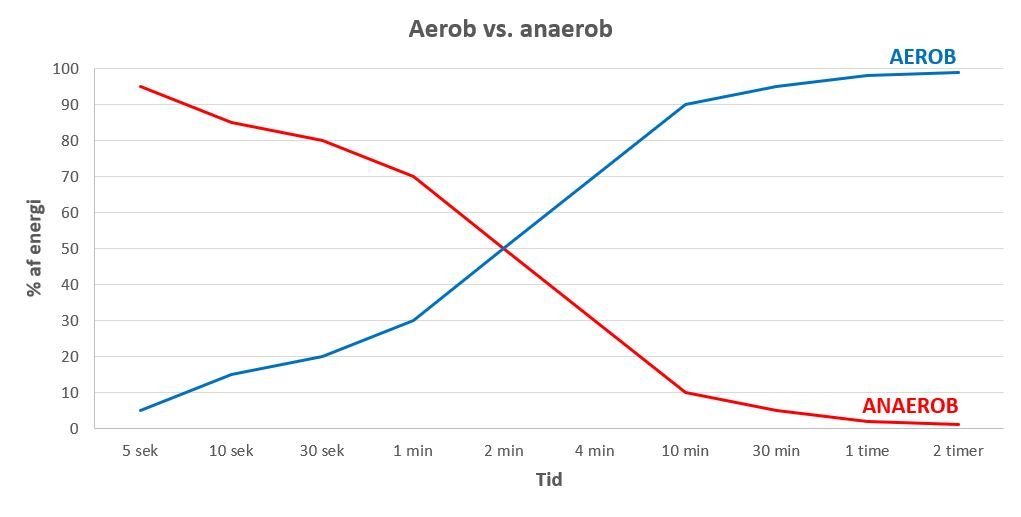
The figure above shows the relationship between intensity and energy system. When the work is very short and intense – 5 to 60 seconds – the anaerobic system provides most of the energy.
At around 2 minutes of work, which for fast runners is roughly an 800 m race, energy delivery is about 50/50 between the two systems.
Anything beyond that is primarily aerobic.
The difference can be felt
Since the anaerobic system runs much faster than the aerobic one, you might think it would be best to use it all the time. However, it comes with drawbacks. Drawbacks that can be felt.
The anaerobic system is a less “clean” combustion than the aerobic one. When the anaerobic system is at full throttle, many waste products, including the well-known lactic acid (lactate), are produced. These waste products cause the body's environment to become more acidic (lower pH), leading to heavier breathing, hyperventilation, and the familiar sensation of “muscle burn.”
Intense anaerobic work is therefore not very pleasant, and it cannot be sustained for very long.
The different thresholds
In daily training, you often hear about different “thresholds.” Terms like: The aerobic threshold, the anaerobic threshold, AT, Functional Threshold Power (FTP), Critical Power, lactate threshold, ventilatory threshold and many more are used interchangeably, causing confusion about what they mean.
Physiologically, it makes sense to only discuss two thresholds: The aerobic threshold (AeT) and the anaerobic threshold (AT). These thresholds are best measured by examining how hard you breathe during physical work with increasing intensity.
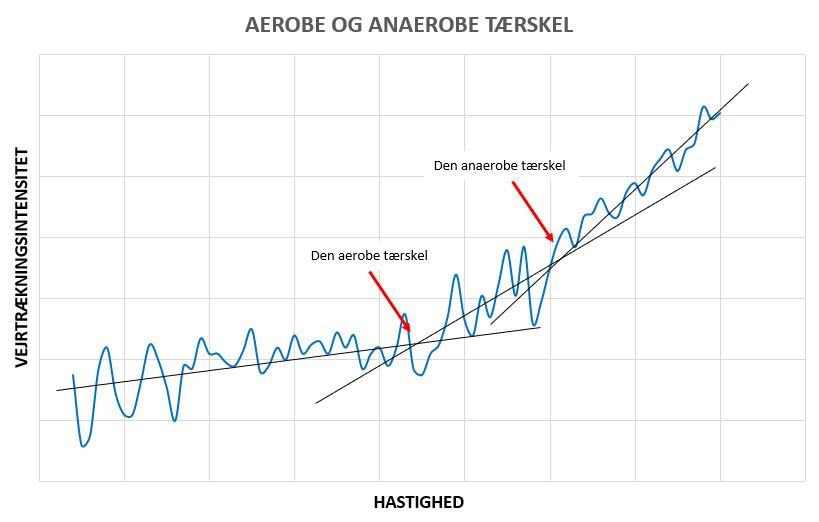
The aerobic threshold is reached when the aerobic processes alone cannot supply enough energy. The anaerobic system steps in to help supply some of the energy. This causes a slight increase in waste products, but not more than you can still maintain a steady level. Breathing intensity increases slightly, but you can still hold a strained conversation.
If the pace and intensity increase further, you eventually reach the anaerobic threshold (AT). Beyond this threshold, waste products accumulate faster than you can clear them, leading to a rapid build-up. Breathing increases further, you start to hyperventilate, and you can no longer speak in full sentences. Continuing at this pace will eventually lead to muscle fatigue, forcing you to stop.
So what is Garmin trying to say?
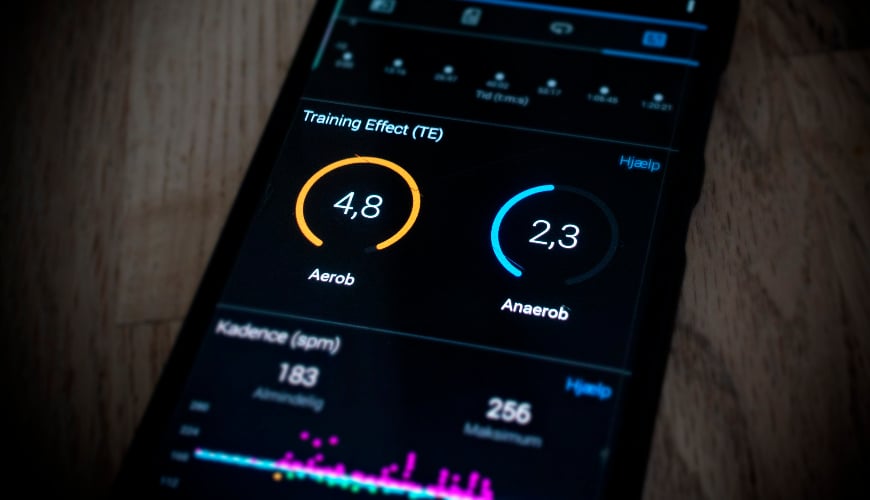
When your , as shown in the image at the top, displays “Aerobic = 4.8” and “Anaerobic = 2.3,” it's indicating how much you've stressed these two energy systems during the activity you've just completed.
It uses the aforementioned thresholds, which they define slightly differently, combined with heart rate data, to estimate how aerobic and anaerobic your run was.
A relaxed long run, where your heart rate never exceeds what has defined as the lactate threshold (the anaerobic threshold), will primarily show as aerobic stress on Garmin. The same goes for threshold intervals run at a pace just below the anaerobic threshold.
If you run classic VO2max intervals, where the intensity is higher, and you approach the anaerobic threshold, Garmin will show it as both aerobic and anaerobic stress.
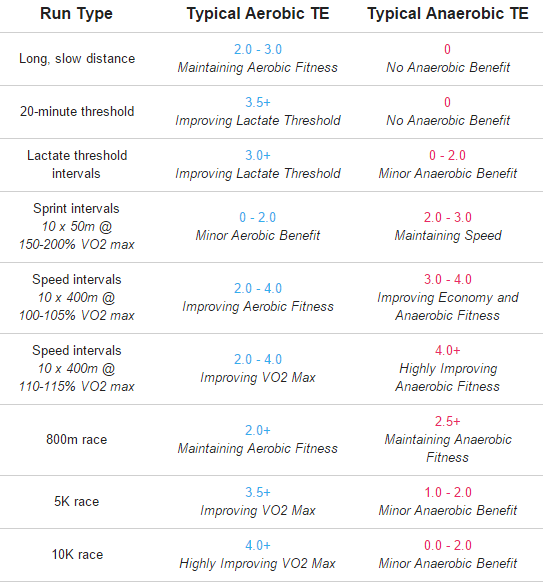
If you run short and very intense hill sprints but otherwise run the rest of the session calmly, Garmin will show it primarily as anaerobic stress. The same applies if you run 400 m intervals at very high speed. Below you see a chart with examples of different runs and how Garmin will assess the training effect of each run.
Your Garmin watch doesn't know everything
Data from your running watch should always be taken with a grain of salt. Even if you have the most advanced and expensive new watch, it can only measure your heart rate. These heart rate data are compared against normal values from data on many people, but it's not certain they match your own physiology. Your Garmin doesn't measure your lactate threshold (anaerobic threshold), it makes a qualified guess.
For the most part, the good rule of thumb that in easy training you should be able to hold an effortless conversation, in moderate training a strained conversation, and in hard training you shouldn't be able to speak in full sentences, works just as well. These three steps mark the transitions between the aerobic and anaerobic thresholds.
More inspiration?
Find more articles in our inspiration universe.