
HRV: Understand your watch's (perhaps) most important recovery metric
Have you noticed that your watch displays something called HRV? Maybe you know it has something to do with heart rate, but not exactly what it means for you or your training?
HRV measurements have become a standard feature on many new sports watches, but for many runners, the three letters remain a mystery. It's unfortunate because HRV is a valuable metric that can assist you in your training.
In this guide, you'll get a thorough explanation of what HRV really is, why your watch measures it, and how you can use it in your training. Whether you're a beginner or an experienced runner, understanding HRV can give you an edge in your training.
What is HRV?
HRV stands for "Heart Rate Variability", which can be translated to heart rate variability. It measures the variation in the time interval between your heartbeats. Still sound a bit technical?
Let me try to explain it even more simply: Your heart rate tells you how many times your heart beats per minute. For example, 60 beats. But HRV measures something else, namely how much the time between individual beats varies.
Two people can have the same heart rate of 60 beats per minute but very different HRV. One person's heart may beat very rhythmically with almost identical intervals between beats. The other person's heart rhythm varies more. One beat comes after 0.95 seconds, the next after 1.05 seconds, and so on.
How HRV is measured
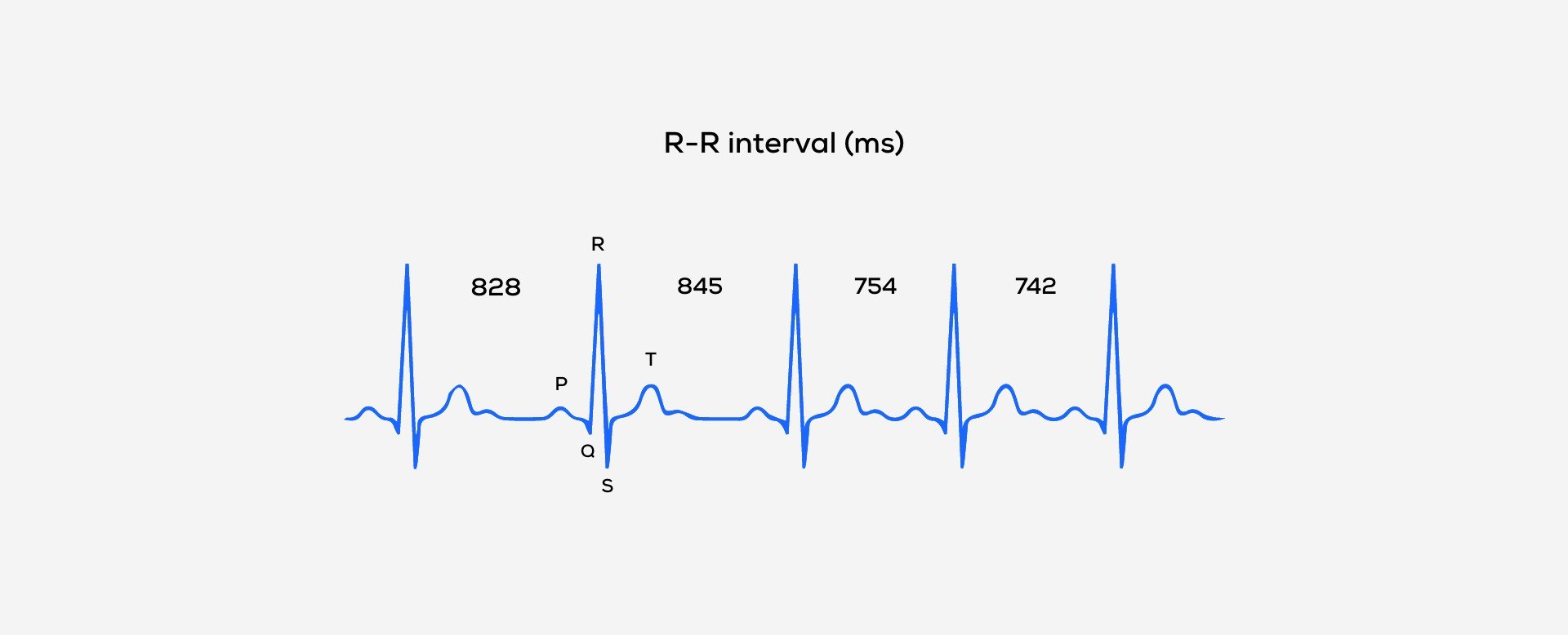
When you see a heart rhythm diagram (an ECG), heart activity is shown as a line running horizontally with regular upward spikes at each heartbeat. This spike is called the "R-wave".
HRV measurement involves analyzing the time from R-wave to R-wave and comparing these intervals with each other:
- High HRV: The time between R-waves varies more – there is a greater difference in the intervals.
- Low HRV: The time between R-waves varies less – the intervals are more uniform.
Why is HRV interesting for your training?
HRV is directly influenced by your autonomic nervous system. It is the part of the nervous system that regulates the body's unconscious functions like breathing, digestion, and heart rhythm [1].
The autonomic nervous system consists of two parts that work together:
- The sympathetic nervous system: Activated by stress, exercise, and activity. It increases heart rate and prepares the body for action.
- The parasympathetic nervous system: Activated during rest and recovery. It lowers heart rate and promotes rebuilding.
A high HRV indicates that the parasympathetic nervous system is dominant, meaning the body is in "recovery mode". The body is functioning well and can quickly switch between activity and rest. A low HRV suggests that the sympathetic nervous system is dominant, which can be a sign of stress, overload, or insufficient recovery.
HRV as a training guide
You can use HRV as an indicator of your body's condition:
- High HRV: Your body is well-recovered and ready for hard training sessions or interval training.
- Low HRV: Your body needs light training, recovery, or rest.
HRV can be a valuable tool to detect early signs of overload before the body develops injuries or you become ill. You might feel mentally ready for a hard session, but your HRV indicates that your body needs rest.
What affects your HRV?
HRV is a sensitive measurement that responds to many different influences [2]. Research shows that HRV varies between individuals and from day to day for many reasons:
Therefore, it's important to see HRV as one part of a bigger picture. A single low measurement doesn't have to be alarming, but if you see a pattern over several days, you should listen to the signal.
How HRV is measured in practice
Many new sports watches from both Garmin and COROS offer advanced HRV measurement. Both brands primarily focus on nocturnal HRV (HRV measured during sleep), which is the most reliable way to measure.
Why nocturnal HRV?
HRV can, in principle, be measured at any time of the day, but measurement during sleep has several advantages that make it the preferred method for training management [1]:
- Minimal influence from external factors: At night, the body is free from many influences that can distort HRV measurements during the day, such as physical activity, caffeine, meals, emotional reactions, and acute stress. This provides a more stable and reliable picture of your body's basic state [3].
- Consistent measurement conditions: When you sleep, the body is in the same state night after night, making it possible to compare measurements meaningfully. Daytime measurements can vary greatly depending on what you're doing. Are you sitting still, walking, stressed over a deadline? During sleep, conditions are more uniform.
- Reliable across sleep stages: Research shows that nocturnal HRV remains reliable even across different sleep phases and even with disturbed sleep, supporting its use as a robust tool for assessing cardiovascular health and recovery [4, 5].
- Automatic and effortless: You don't have to remember to take a measurement. The watch does it automatically while you sleep. This ensures consistent data without extra effort. That's why both Garmin and COROS have chosen automatic nightly measurement as their primary HRV feature.
How to get started with HRV measurement
When you buy a watch with HRV measurement, there are some basic principles that are good to know to get the most out of HRV tracking:
Establish your baseline
Garmin: Wear the watch when you sleep for about 19 consecutive nights. Avoid training extremely hard or drastically changing your habits during this period. You will have a representative picture of your "normal" level.
COROS: Wear the watch when you sleep for 5 nights. The same principle applies. Try to have a somewhat normal period.
Consistency is key
To get reliable data, wear the watch every night when you sleep, and make sure the watch fits correctly.
Look at trends, not single measurements
Your HRV will naturally fluctuate from day to day. The important thing is the pattern over time. Is your HRV consistently low for 3+ days? Consider taking a rest day. Do you see a gradual decline over a week? You might be overtraining. Does your HRV increase after rest days? A good sign that the body is recovering.
Combine with other signals
HRV is a tool and not the whole truth. Use it along with how you feel subjectively, your sleep quality, your appetite and mood, any signs of illness, and Body Battery (Garmin) or daily stress score (COROS).
Advanced tips for HRV users
Once you've used HRV for a few months and know your normal level, you can start using it more strategically:
Periodization of training
Use HRV to manage your training cycle. In a period of high HRV, it's the perfect time to increase training volume or intensity. With normal HRV, continue with your planned training. If you see a declining trend over several weeks, plan a recovery week.
Before important competitions
Monitor your HRV in the week leading up to an important race or event. 7-10 days before, your HRV should rise as you taper down. If HRV suddenly drops 2-3 days before, it may be a sign of impending illness. A high HRV on the morning of the race day is typically a good sign.
Identification of illness
HRV can often drop 1-2 days before you feel symptoms of illness. If your HRV drops significantly without an obvious reason, be extra attentive to your body in the coming days.
Lifestyle optimization
Use HRV to see how different factors affect you. Compare HRV after evenings with and without alcohol, see the effect of different bedtimes, observe the impact of caffeine intake, and feel the difference between stressful and relaxed periods.
Frequently Asked Questions
Why does my HRV vary so much daily?
It's normal. HRV responds to many factors from sleep to stress to what you ate for dinner. That's why we look at trends over time instead of single readings.
Can I improve my HRV?
Yes, over time you can improve your baseline HRV through consistent good sleep, appropriate training load (neither too much nor too little), stress management, good nutrition and hydration, and by avoiding alcohol and smoking.
When should I measure HRV?
For most, nightly measurement (Garmin and COROS Overnight HRV) is most reliable, as you are relaxed and free from external influences. If doing manual measurement, do it at the same time each morning, before getting up, in the same position.
Is higher always better?
Not quite. Your HRV should be within your normal range. Extremely high HRV can actually indicate overtraining or that the body is in an abnormal state. It's about balance, not maximum numbers.
Should my HRV be like my training partner's?
HRV is extremely individual. One person's "normal" HRV at 30ms can be just as healthy as another's at 80ms. Compare only with yourself, not others.
Does one low reading mean I'm sick?
HRV fluctuates naturally. It can be affected by a bad night's sleep, a glass of wine the day before, or work stress. Look at trends over 3-7 days before drastically changing your plans.
Conclusion: HRV as a tool, not a dictator
HRV is an incredibly powerful tool to understand your body's state and optimize your training. It provides data on something that can otherwise be hard to measure – namely how well recovered you are.
But remember: HRV is one number among many. It should be used alongside your subjective feeling, mood, sleep quality, and common sense. Don't let numbers completely control your life, but use them as a guide to make better decisions.
Ready to start with HRV measurement?
Hopefully, you are now more informed about HRV, why it's interesting for you, and how you can use it in your training.
Don't have a watch that can measure your HRV yet? Then check out our full range of
, where you find models from both
and
with advanced HRV tracking.
Need equipment for recovery or training, find a wide selection in our
and
.
Contact us if you have questions or want to know more about which watches suit your needs and training.
References and Sources
[1] Task Force of the European Society of Cardiology and the North American Society of Pacing and Electrophysiology (1996). Heart rate variability: Standards of measurement, physiological interpretation, and clinical use. Circulation, 93(5), 1043-1065.
[2] Sandercock, G. R., Bromley, P. D., & Brodie, D. A. (2005). Effects of exercise on heart rate variability: inferences from meta-analysis. Medicine and Science in Sports and Exercise, 37(3), 433-439.
[3] Nordjysk Speciallægeklinik (2024). Heart Rate Variability (HRV): An important health indicator. Available at: https://www.nordjysk-speciallaegeklinik.dk/hjerterytmevariabilitet-hrv-en-vigtig-indikator-for-helbredet/
[4] Shaffer, F., & Ginsberg, J. P. (2017). An Overview of Heart Rate Variability Metrics and Norms. Frontiers in Public Health, 5, 258. doi: 10.3389/fpubh.2017.00258
[5] Bumatay, N., Zhang, H., Covassin, N., Punjabi, N. M., Baum, S. A., Brinton, R. D., ... & Maki, P. M. (2024). Nocturnal heart rate variability across sleep stages in midlife women. American Journal of Physiology-Heart and Circulatory Physiology, 327(1), H186-H195.