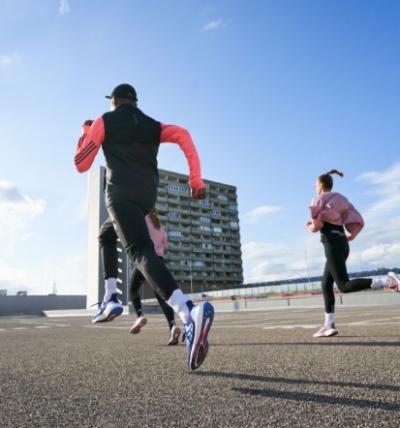
In autumn and winter, it's dark both on the morning run and when you get home in the afternoon and just need to squeeze in a run before dinner. As a runner, you need to be visible to traffic, whether you're running in the city, on the highway, or on unlit paths. These three places have different requirements.
A reflective vest serves two different purposes, depending on the type you choose. Reflectors bounce light back when light hits them. LED lights emit light themselves, regardless of nearby streetlights or cars. These two features work under different conditions, and most vests combine them.
This guide goes through the types and concepts one by one, so you know what you're buying and what actually makes a difference on your routes. If you run in the dark, it might be a good idea to supplement your reflective vest with a headlamp. Also, read our article on .
Vest, Harness, or Small Reflectors?
The Vest is the classic solution. A continuous panel front and back with reflective stripes, often supplemented with LED. The advantage is area: there's a lot of reflector to hit, and it stays stable when you run. The downside is warmth and airflow, as a panel over the chest blocks it.
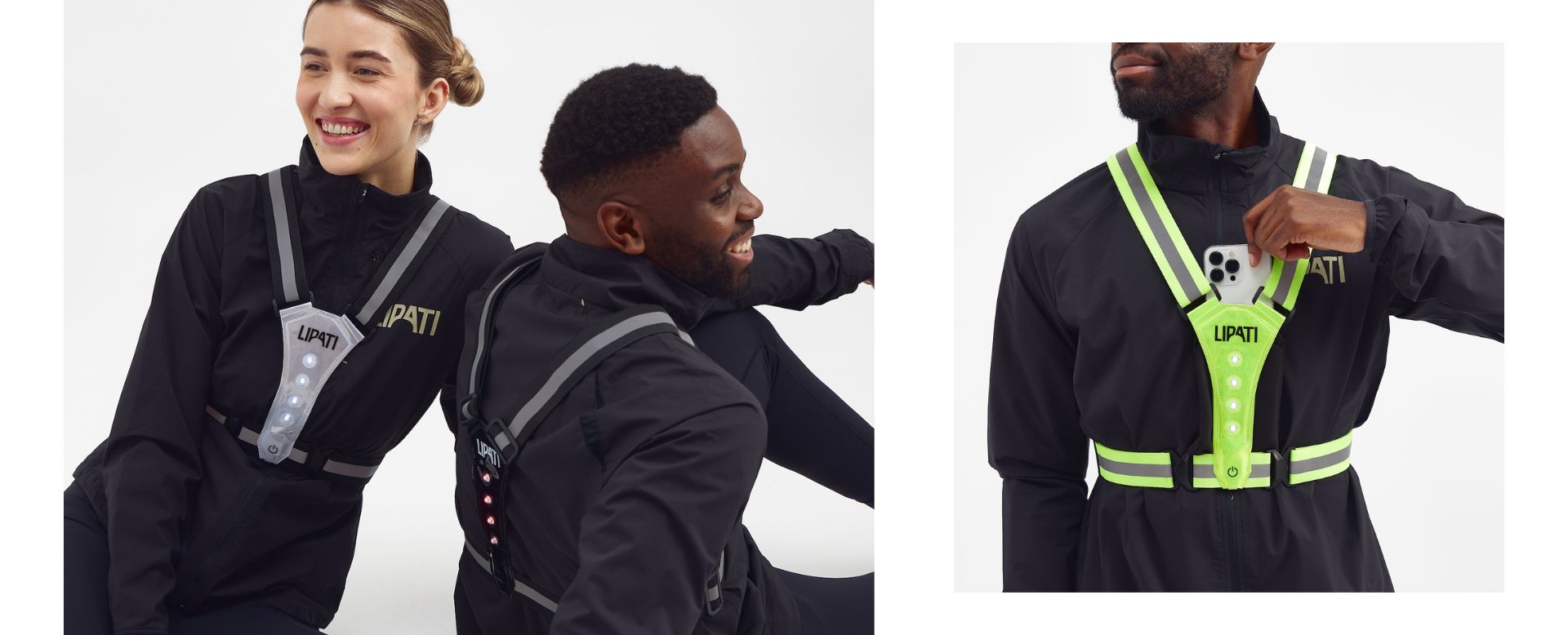
The Harness offers the same functions distributed on narrow straps instead of a panel. It's lighter, less warm, and easier to put over a thicker winter jacket. However, there's less reflective area, so it's more dependent on the LED light being on. The harness is also the easiest to carry in your pocket if you only need it for part of the run.
Be aware that most harnesses are sold as "vests," even if they're made of straps. Some are called Harness. To know what you're getting, the picture is decisive: do the straps run over the shoulder and chest, or is there a continuous piece of fabric?
Small Reflectors are bands and clips for wrists, ankles, belts, or backpacks. They don't replace a vest but cover something the vest can't: movement and low placement on the body.
Reflective, LED, or Both?
Reflectors require a light source to work. If there are car headlights, streetlights, or headlamps nearby, they shine back brightly. Without a light source, they do nothing. That's why reflectors work well in traffic but don't provide much visibility on an unlit gravel road.
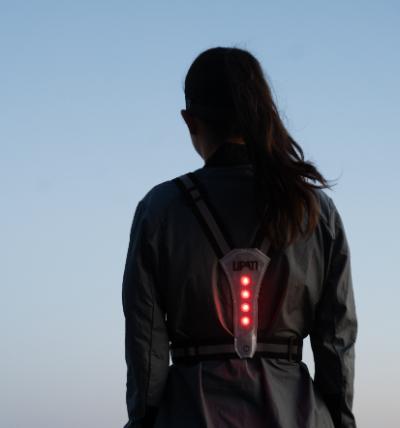
LED lights work independently of the surroundings. White light in front and red at the back follow the same logic as on a bike, so traffic can see which direction you're moving. Most models can both shine steadily and blink.
The blinking function is worth using, even where there are streetlights. In the city, the problem is rarely that drivers can't see anything, but that there's a lot to see. At intersections, exits from parking lots, and places where a car needs to turn across your path, a blinking point is something the eye is drawn to, while a reflective stripe is just a light surface among many. So the argument for LED isn't just about dark highways but can also be a good choice in busy areas where you want to be seen.
In practice, the combination is the strongest: reflectors that work passively all the time, and LED that makes you actively visible when there's no other light or when you need to catch someone's attention.
Understanding Product Names
Manufacturers use different words for the same thing. Here are the terms you most often encounter in product names and on labels, and what they cover.
Light and Reflector +
| Reflective | Reflective material. Bounces light back and requires a light source to work |
| LED | Active light. Works regardless of ambient light |
| Glow | Glow-in-the-dark material. Charges in daylight and glows faintly afterward |
| Hi-Vis, Neon | Bright signal color. Works in daylight and twilight, not in darkness |
| 360 | Visible from all angles, including the side |
Type and Fit +
| Vest | Continuous panel front and back. Most reflective area |
| Harness | Narrow straps instead of panel. Lighter and less warm. Also sold as vest |
| Band, Wrap | Bands for wrist or ankle |
| Clip | Small light or reflector clipped to belt, pocket, or backpack |
| One-size | Adjustable with elastic and straps. Fits over both shirt and jacket |
| Phone Pocket | Pocket on chest for phone |
Power +
| USB, USB-C | Rechargeable. Charger usually included |
| Battery | Button cell or battery that needs replacing |
Reflective Vests Without Light
The simplest solution, and the cheapest. No charging, no electronics, nothing that can stop working mid-run. It works best where there's already light. On a lit road or in traffic, there are always car headlights and streetlights to activate the reflectors. If you choose a vest without light, it's worth supplementing with a reflective band around the ankles, as this adds movement to what the driver sees.
LED Vests and LED Harnesses
Here you get both reflectors and active light in the same product, which is why most end upwith one of them. White in front and red at the back, typically with both steady light and blink, and rechargeable battery on most models.
The difference between the models is mainly in three areas: how much reflective area there is beyond the light, whether it's a vest or a harness, and if there's a pocket for the phone.
Small reflective products
Bands for wrists and ankles, clip lights for belt and backpack, and rear-facing blinks. They cost little, weigh nothing, and cover areas on the body a vest can't reach.
Ankle bands give the most value for money. They move with your step and sit low where car lights hit first. That's why placement matters more than quantity: a driver recognizes a person faster from something moving in a fixed pattern than from a large, stationary surface.
A clip light on the back covers the other direction. If a car comes from behind, it only sees what's on your back, and the vest solves that with reflection alone.
If you run with a dog, it also counts here. The dog moves to the side, so the width a driver must consider is larger than you alone.
Choose based on where you run
The chart is a starting point. How much you need depends on traffic volume and how much light is already on the route.
Road and city +
| City with streetlights | Reflective vest or harness. Flashing LED can be an advantage at intersections and exits where cars must turn across your path |
| Country road without sidewalk | LED vest with white in front and red at the back. Optionally supplement with ankle reflectors |
| Bike path along road | Rear-facing light is most important. Cyclists come from behind at higher speeds than you |
Path, forest, and trail +
| Unlit path | Reflectors do nothing without a light source. Active light or headlamp is necessary |
| Forest with other runners | Headlamp over vest. Your reflector throws their light back in their face and ruins night vision for those behind you |
| Road to and from the forest | Vest on the asphalt, and off again inside the trees. A harness is easiest to carry in the pocket |
The combination of reflector and active light covers the widest range. Reflectors work passively all the time, LED works where there's no other light.
Being seen is not the same as seeing
A vest makes you visible to others. It doesn't light the way ahead of you. If you run on gravel, path, or in the forest, it's the headlamp that determines if you can see roots and unevenness. We have a separate guide for that part:
The rest of the winter gear
Visibility is in place, but the dark months are also the cold ones. Fingers and ears feel the cold first, and a pair of
and a
take up almost no space in the pocket if you get too warm along the way. On the legs, a pair of
handle most of the winter, and on top, it's the
that keeps wind and rain out. Many jackets have built-in reflectors, but rarely enough to stand alone.
If you need to manage the entire wardrobe, or if you're unsure about the outer layer, you can read more here: