
Many runners look at pace, distance, and fatigue to assess if training is on the right track. Fewer monitor the resting heart rate. It's a bit unfortunate because over time, it can provide a good indication of how the body adapts to the training you do.
What is resting heart rate?
Resting heart rate is the number of heartbeats per minute in complete rest. The best measurement is in the morning before getting up, ideally before coffee, phone, or other activity. The more relaxed, the more accurate.
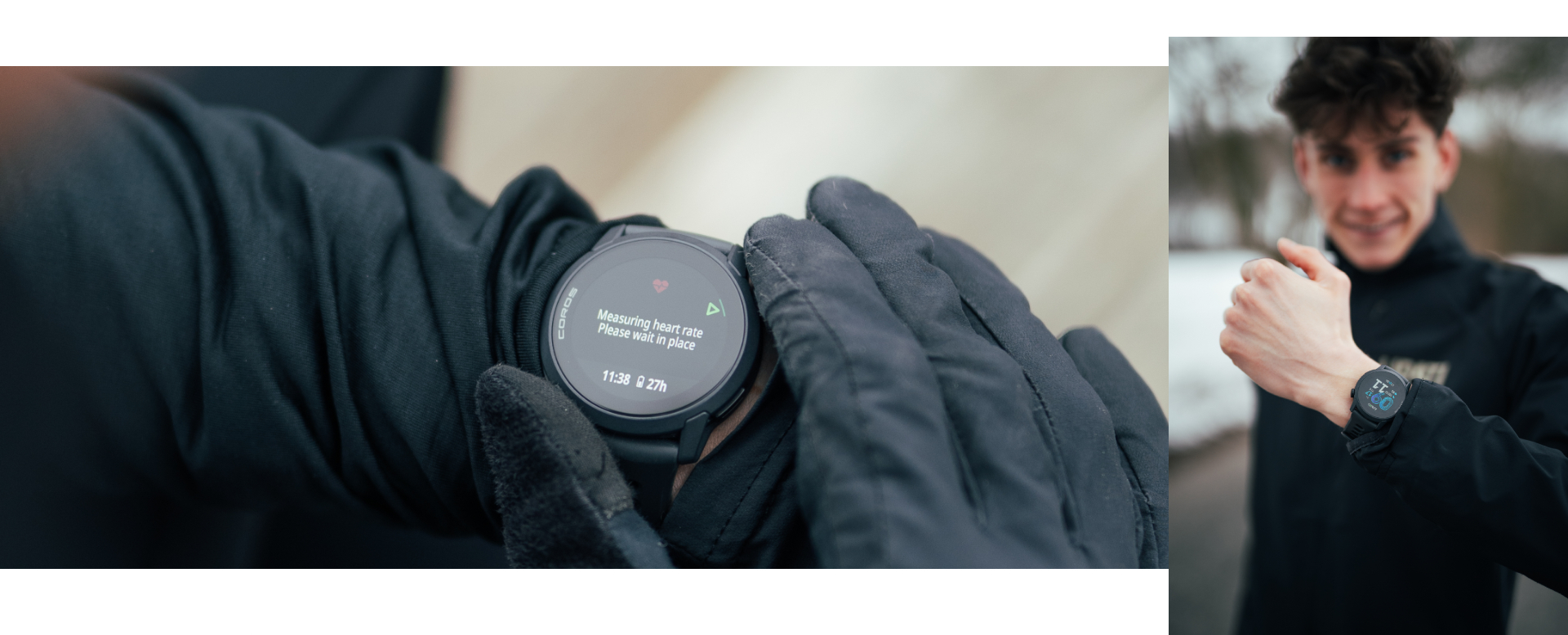
If you have a running watch, you can typically see your resting heart rate directly from it. Watches from Garmin, COROS, and Huawei record it continuously, and many runners check it in the morning while still in bed. For most runners, this provides a sufficient picture, especially when tracking the trend over time rather than focusing on individual readings. If you don't have a watch, you can measure manually with two fingers on the neck and count beats for a minute.

Is my resting heart rate normal?
The Heart Association states that a normal resting heart rate is around 60 beats/min for men and 70 for women. But "normal" covers the entire population and isn't necessarily the most meaningful comparison if you're an active runner.
Among well-trained endurance athletes, resting heart rates of 40–50 beats/min are common, and even lower among elite athletes. It's not a goal in itself, but it reflects that the heart adapts over time to regular endurance training. The most useful approach is probably not to compare with an average but to track your own resting heart rate over time and see how it develops.
What happens to my resting heart rate when I run?
Regular endurance training seems to lower the resting heart rate over time. This is likely because the heart gradually becomes better at pumping blood. Thus, it can send more blood with each beat and doesn't need to beat as many times per minute.
A meta-analysis from 2018 (Reimers et al.) found that fitness training generally lowers the resting heart rate, with the greatest effect in those with the highest starting resting heart rate. It typically takes several weeks to months before you see a noticeable change. It's not something that happens from one week to the next.
Both low-intensity training with high volume and high-intensity training like intervals seem to contribute, and a combination of both is probably sensible for most runners.
Resting heart rate as a daily guide
This is perhaps most interesting for runners in practice. Because the resting heart rate is affected by many factors – sleep, stress, illness, alcohol, dehydration, and training load – daily fluctuations can indicate how the body is doing.
If your resting heart rate is noticeably higher than your normal level one morning, it may be a sign that the body is under some form of stress. It's not a diagnosis, but it can be a signal to adjust the day's training or at least reduce the intensity. How significant a deviation is meaningful varies from person to person. Many use 5–8 beats above their normal level as a rule of thumb to consider such adjustments, but it's a guideline, not a fixed rule.
| Deviation from your normal level | Possible indication |
|---|---|
| At level or lower | Good recovery |
| 0–4 beats higher | Within normal daily variation |
| 5–8 beats higher | Consider adjusting today's training |
| 8+ beats higher | Easy training or rest day |
The numbers are guidelines and vary from person to person.
HRV – a step further
Resting heart rate isn't the only measurement that can indicate how the body is doing. Many modern running watches also measure HRV (Heart Rate Variability). It's a related but more nuanced measurement that looks at the variation between individual heartbeats rather than their number.
HRV and resting heart rate are affected by many of the same factors and are often used side by side in watches from , and . If you want to understand what HRV actually measures and how to use it actively in your training, we've written a separate guide on just that. Read our article on HRV here.
How do I start using my resting heart rate?
The most useful approach is probably to start by establishing a baseline. Track your resting heart rate daily over a few weeks of normal training. Here you can learn to recognize your own normal level. It's only when you know what's normal for you that fluctuations begin to make sense.
From there, it's about using it actively. If your resting heart rate is noticeably elevated one morning, it may be a signal to adjust the day's session. If you see a gradual decline over weeks and months with regular training, it may be a sign that the body is adapting well. If your resting heart rate remains persistently elevated without being ill or in a period of unusually high stress, it may be worth considering if recovery is sufficient.
It doesn't take much. But if you're already running with a watch, the resting heart rate is likely already available. It's just waiting to be used.
Control your pulse – what's next?
If you're intrigued, HRV is a natural next step. It's a related measurement that can give you an even more nuanced picture of your recovery. Read our
.
If you want to start running training or upgrade your gear, find our full selection of
,
and
here.
References
- Reimers AK, Knapp G, Reimers CD. Effects of Exercise on the Resting Heart Rate: A Systematic Review and Meta-Analysis of Interventional Studies (2018)
- The Heart Association – Pulse and heart control (https://hjerteforeningen.dk/hjaelp-og-rad/fakta/puls-og-styring-af-hjertet/)