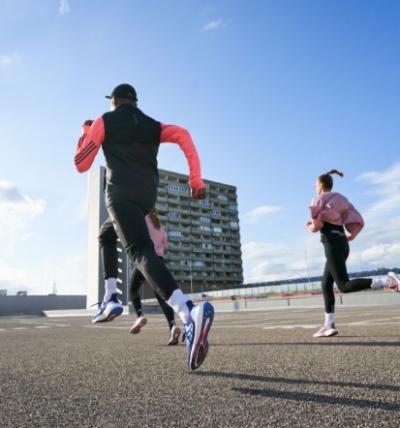



Long roads. Threatening trees behind fields. The wind is broken by your neck warmer and hat. Hopefully, it's at your back. You're deep into winter training. And your training requires discipline for continuity. Discipline requires equipment you can rely on through many months, so you know what you're working with.

has received a full update, including upper, mid, and outsole. Last year’s model appealed to me, mainly because the shoe promised the same feel from the first kilometer to the last; this year tells a different story – except I'm still fond of it..
The shoe is for those who want a comfortable volume training shoe offering more than the entry model. It no longer excels “just” in continuity. Instead, it promises low weight, more shock absorption, and technologies we know from .
Who should buy adidas Supernova Rise 3?
For many, Supernova Rise 3 will make sense. If you need a volume training shoe, you MUST almost consider this shoe, and if you want one shoe that can take you through different tempos and terrains, you won’t find a better option for the price.
adidas Supernova explained
| Model | Primary function | The shoe is for... |
| Supernova Glide | Basic | those needing a solid, traditional running shoe |
| Supernova Solution | Stability | those needing extra support |
| Supernova Rise | Versatile | those wanting a balance of weight, comfort, and stability |
| Supernova Prima | Shock absorption | those wanting maximum comfort |
Supernova Rise 3 – Goodbye stability, expect speed
This year, Rise steps away from stability in its quest to balance the holy trinity of running shoes: Weight, comfort, and stability. Instead, the focus is on weight, and at 272 grams in size US9, it's slightly lighter than its predecessor.
This has been achieved in several ways. One specific way is the omission of Support Rods, which characterized Rise 2’s outsole. Instead, you find a full midsole of Dreamstrike+ foam, where the predecessor used stabilizing EVA rods.
The omission not only results in lower weight. I also feel it in my push-off, especially at higher speeds. I've used the shoe for volume training, but, as I did with its predecessor, also for training resembling marathon intensity (AT). Here, where the body needs to push extra into the ground, the new midsole shines: It feels lively and returns energy.

In the two months I've tested it, the shoe has gone from a fixed volume trainer to a shoe where I don't need to bring a spare shoe for a session. The shoe is hybrid enough that I want to use it as much as a volume trainer as an interval shoe. Very few shoes have made that journey in my mind, and that's a quality stamp.
A lot of this journey relies on the new midsole. Adidas claims Supernova Rise 3 is 20% softer. For me, it's hard to feel. Dreamstrike+ is unique, being a PEBA blend; yes, the same PEBA found in elite shoes with clear traits: Soft but very energy-returning.
I can't fully agree with “soft” here, as the shoe primarily feels firm, which is mixed for me: On one side, the firmness is what makes the shoe hybrid for me. On the other, the firmness compromises the weakest link of the three holy, namely comfort.
I don't mean Supernova Rise 3 is uncomfortable. The shoe fits well thanks to a good upper (more on that soon), and Rise 3 delivers a good push-off. But the shoes don't have the shock absorption many expect from volume trainers today. But maybe it’s because the standard has been raised tremendously among running shoes generally, regarding comfort. Despite the midsole’s 20% softer update, adidas maintains the stance for shoes that feel more conservative.
Primeweave – Thin and technical upper
While the midsole update involved adding more of the same foam, the upper is entirely different from last year. Gone is the classic (and heavy) sandwich mesh, making way for the Primeweave upper, a finely knitted upper that is not only lighter but also adapts better to the foot.
At first glance, the upper seems like a downgrade, but when you hold it, it's clear the upper is more technical than its predecessor. Much fabric is saved without making the upper porous.
I'm not afraid to hit forest paths and uneven surfaces in the shoe, as the upper will keep me in place on the midsole.
Like the conservative firmness of the midsole, Supernova Rise 3 uses a classic heel cap. You're locked in place but only where it's beneficial: Heel and under ankle are fixed without reducing mobility.
The new mesh upper counters the feeling of being locked in with its elastic feel. Comfort is generally improved, which is why adidas also recommends the shoe up to marathon distances. The seemingly downgraded upper has proven to be one of adidas' best choices for the shoe.
Adios Pro 4-worthy outsole: LightTraxion
As with the upper, the outsole is entirely different from before. Here, too, you find technology previously used in more expensive and faster Adizero shoes, namely LightTraxion, which I previously praised.
The rubber material helped me safely through the test period. A period that included Denmark's coldest January in twenty years and reasonable amounts of snow: Not a runner's dream. But with the right equipment, training proceeded as planned.

Even though the shoe is lighter and has a midsole worthy of Adios Pro 4, I'm not in doubt that the shoes will deliver roughly the same mileage as I ran in its predecessor. I covered 2000 kilometers in the previous model before the upper showed signs of wear.
I have a feeling I’ll have just as hard a time wearing down this shoe.
Why should you buy adidas Supernova Rise 3?
You should buy the shoe because Supernova Rise 3 does many things well simultaneously. The shoe is light, responsive, and will be hard to wear out.
If you prefer a lower, firm shoe where you don't risk twisting your ankles on uneven surfaces, adidas Supernova Rise 3 is one of the last shoes on the market that genuinely feels this way.
The shoe is for those who want one shoe for many purposes: The ideal swiss army knife