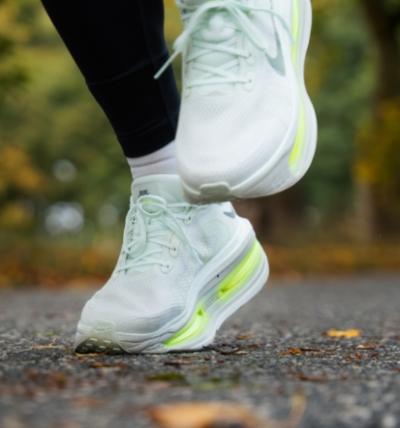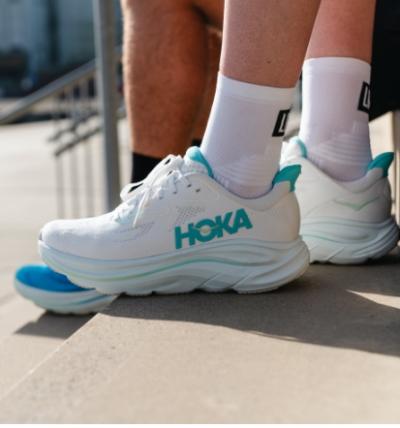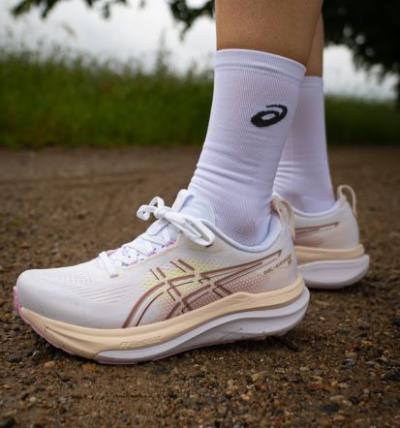



Today, we will discuss one of Nike's most iconic running shoes – namely, Nike Structure. That a shoe can reach its 26th edition says a lot about its popularity, and it's worth noting. Another thing that catches attention is when some of the biggest stars in running choose to run in a stability shoe like Nike Structure. We've seen the Olympic champion at 1500m, Cole Hocker, do it – along with his teammates Cooper Teare and Sinclaire Johnson (former American champ at 1500m). It's interesting.
Unfortunately, reality isn't set up for all of us to win Olympic gold at 1500m, and most of us have learned to live with that. That's fair enough. But maybe we can learn a bit from Cole Hocker, as I believe many of us runners could use a bit more stability around the feet, just occasionally.

Nike Structure 26 – specifications
- Type: Stability
- Stack height: 38 mm (heel) / 28 mm (forefoot)
- Midsole: ReactX
- Drop: 10 mm
- Weight: 302 g (men's US 9)
Nike Structure, along with Pegasus and Vomero, has made it through the needle's eye and been selected as the three models to carry the legacy forward as Nike's volume training shoes. Here, Structure is the model offering stability – and like the other two models, Structure will be released in three versions: Icon, the shoe we're discussing in this article, as well as a Plus and a Premium model. This is the new silo structure Nike is building their volume training shoes around.
Nike Structure 26 - The Upper
I must admit, stability shoes aren't what I've run in the most over the years. It hasn't been a conscious choice; I've typically been more curious about many of the neutral volume training shoes. But when I last tested a shoe with stability features (Tempus), I had a really good experience. Therefore, I've also been excited to lace up my Structure 26 and hit the trails.
Structure 26 has been updated in several areas, although not completely redefined, as was my experience with Vomero 18. The upper is made in engineered mesh material, a bit hard to say exactly what it is, but there is plenty of structure in the fabric, making it good for providing a stable feel around the foot. On the upper, Nike has focused on comfort around the heel and tongue, and it has succeeded really well. Overall, it's an upper built to keep your foot in place, and it's really nice.
The upper is probably on the warm side, while I find Structure 26 to be on the narrower side in its fit, especially at the front in the toe box.

Nike Structure 26 - The Midsole:
The midsole often ends up with the big headlines in reviews – and it does this time too. However, without being thrown onto the front page with a breaking banner. The midsole has been updated to now consist solely of ReactX, combined with a support system called Midfoot Support System. The shoe's stack height is 38 mm in the heel and 28 mm in the forefoot, providing a 10 mm drop.
I think it's the natural next step for a shoe like Structure to get a full-length ReactX midsole. It wouldn't make sense to add ZoomX in this model – maybe we'll see it in Plus or Premium versions. It's exciting. The midsole is firm, yet not dead in any way, and the Midfoot Support System ensures your foot stays centered without too many small twists. Exactly what you seek in a stability shoe.

Nike Structure 26 - How does it feel?
I've used Structure 26 on various runs, and I think I understand why professionals like Cole Hocker and Sinclaire Johnson train in this shoe. It's like a good friend you need to get to know, but once you do, you can't do without.
Structure 26 is what you'd call a workhorse, I'm pretty sure Cole Hocker would call it that, and now I'm on his team, so I call it that too. An untiring workhorse, simply.
As an experienced runner, I've used the shoe on days after hard intervals, when my body and tendons were a bit stressed. I've also used it to and from workouts on the track and for regular easy runs of up to an hour. Somehow, the shoe feels lighter than it is, which I believe is due to the foam not being ultra-soft, but rather more responsive. However, with significantly more comfort than in previous versions.
Nike Structure 26 - Who should consider this shoe?
I think Structure 26 appeals to a very broad audience. Besides the Olympic winners and types like me with some years of experience, I also think this shoe will be really useful for beginners in need of stability.
Nike Structure 26 is helping to push back against the notion that stability shoes are boring, and that pleases me greatly. It does so by being modern in its expression and material choice, relatively light, and with a generally high comfort level from top to bottom.
Now I will run my Structure 26 to exhaustion, if that's even possible, and then I will look forward to getting my hands on Structure 26 Plus and Premium. With this Icon version, expectations have only risen higher.
Need inspiration?
Find more articles in our inspiration universe right here: