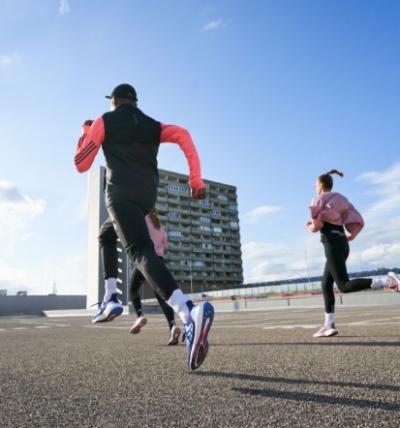

This article is prepared by LøberLab. LøberLab are specialists in evidence-based training and work to optimize runners' performance through the latest research and physiological knowledge.
You have trained for months. The long runs, the tough intervals, the early mornings. Now race day approaches, and you have a feeling many runners know: should I really train less now? Won't I just lose my form?
It's a reasonable question, and the answer is reassuring. Done right, the last weeks of tapering won't make you weaker. It makes you faster on the day itself. Here you get the physiology behind it, and what research actually says about how you should taper.
What "form" really is
To understand tapering, it helps to separate two things that training builds simultaneously:
1. One is your fitness. It's the capacity you've built over weeks and months. It comes slowly, and it also disappears slowly. A few weeks with less training won't remove the form you've spent a whole season building.
2. The other is your fatigue. It's the acute load that accumulates from recent hard training. It comes quickly, and most importantly: it also disappears quickly.
Your actual form on a given day is the difference between the two. When you train hard towards a race, you have high fitness, but also high fatigue, and the fatigue acts as a lid over the form. What a good taper does is remove the fatigue while keeping the fitness largely intact. So the lid lifts, and your form peaks at precisely the time it matters. That's the whole point of tapering. You don't let go of your training. You let it finally express itself.

What research says about tapering
Tapering is actually one of the best-studied areas in training physiology, and the results are quite consistent. A large meta-analysis by Bosquet and colleagues gathered results from numerous studies and found a clear pattern for what works best. A recent systematic review from 2023 largely confirms the same picture.
The three most important conclusions are:
1. Cut down on volume, not speed.
The most effective is to significantly reduce your total training volume, around 40 to 60 percent, while maintaining intensity. The hard sessions shouldn't be removed. They should just be shorter. It's the fatigue from volume you want to get rid of, not the sharpness that keeps the form.
2. Maintain frequency.
Keep running as often as before. If you cut down the number of sessions, you start to feel rusty and out of rhythm. You just run shorter each time.
3. About two weeks works best.
For most, a tapering of about two weeks is the most effective, and the benefit holds within a window of up to about three weeks. A good, targeted taper can actually improve your performance on the day by a few percent. It doesn't sound like much, but in a half marathon or marathon, a few percent is several minutes.
In short: run as often, keep the speed in the sharp sessions, and cut the total volume significantly. That's the recipe.
How the last four weeks can look
Thinking four weeks ahead of the race, the rhythm can look something like this:
- Four weeks out is typically when your training peaks in volume, or just has. It's the last period with really big runs before you start easing on volume.
- Three weeks out you start gently trimming the total volume, but keep the structure and hard sessions.
- Two weeks out you clearly taper the volume. Your long runs get shorter, your total week gets lighter, but you keep a few short, sharp sessions so the body still feels speed. You run as many days as always.
- The week before is light. Short and sharp instead of long and hard. Your last really hard session should be a few days before the race, so you're fresh on the day, not drained. The rest are short runs that keep you going and in rhythm.
The exact number of kilometers depends on how much you normally train and what distance you're running. The principle is the same regardless of level: keep the speed and frequency, remove the volume.
The big misunderstanding: tapering is not rest
The trap most fall into is confusing tapering with a break. They fear being tired on the day and end up almost stopping training the last week.
It's the same basic rule as with all training: the body quickly loses what it doesn't use. If you stop completely, you start to feel rusty, heavy, and out of form after just a few days. You shouldn't rest to the start line. You should taper to it, and the difference is important.
Don't forget recovery in the last week
Tapering isn't just about the race. The week before your race is also when sleep, food, and rest really pay off. When the fatigue from training falls, and you simultaneously sleep well and eat properly, that's when the form really comes together. Prioritize sleep in the days leading up. It's one of the most underrated parts of a good taper.
Equipment and recovery tools can support the process, but they don't replace the simple combination of sensible tapering, good sleep, and proper food. It's your training and the way you taper that determines the form on the day.
The article is prepared by LøberLab.
Want to know more?
If you want to read even more about tapering, you can dive into our
, where we go through the concrete plan distance by distance. And if you want to understand the principle behind how the body gets stronger from load followed by rest, you can read our guide to
.
Need to get the practicalities in place for the last weeks, you'll find fresh
and new
with us. Get it in good time, so it's ready before the start. And if sleep and recovery need support in the last week, you can check out our
.
Sources
- Bosquet L, Montpetit J, Arvisais D, Mujika I. Effects of tapering on performance: a meta-analysis. Med Sci Sports Exerc. 2007;39(8):1358-65.
- Wang Z, Wang YT, Gao W, Zhong Y. Effects of tapering on performance in endurance athletes: A systematic review and meta-analysis. PLoS One. 2023;18(5):e0282838.